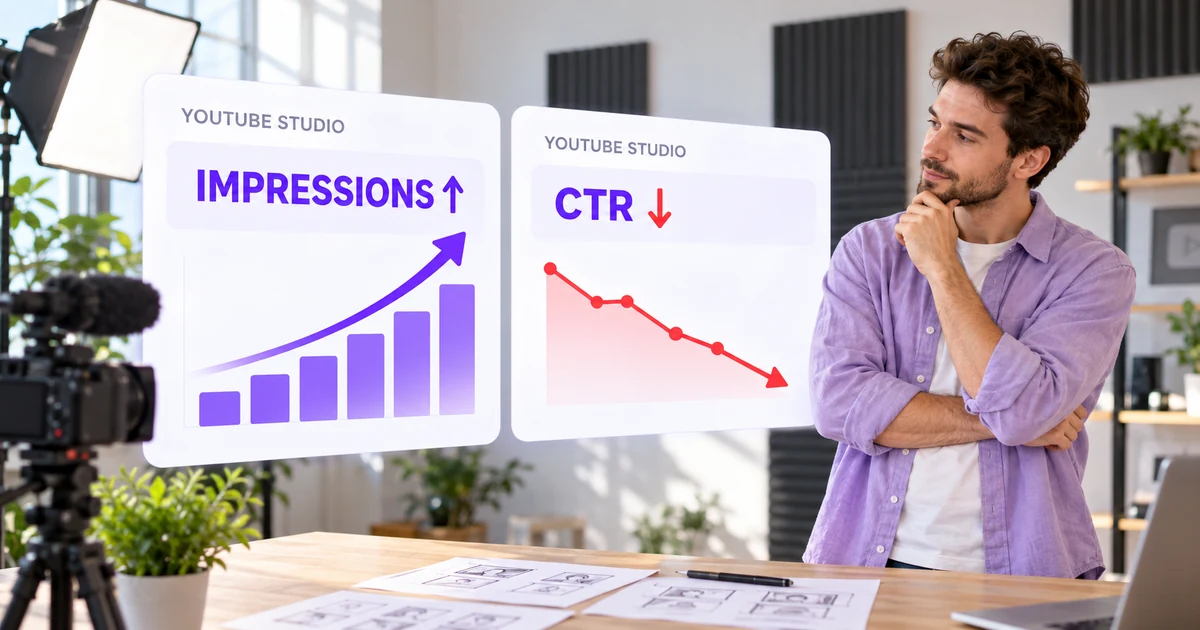
Your video is appearing in front of more people, yet its impressions click-through rate is falling. That combination can look like a warning. Sometimes it is. Just as often, it means YouTube has moved beyond your most familiar viewers and is testing the video with a broader audience.
The useful question is not simply, “Did CTR go down?” It is: what changed around the CTR? Before replacing a thumbnail, compare the time window, traffic sources, audience mix and watch-time response. Those checks tell you whether the package needs work or the percentage is changing for an understandable reason.
Updated on September 25, 2026. Studio labels and report placement can vary by device and account, so use the metric names—not only the menu position—when following the checks below.
Quick answer
When YouTube impressions rise while CTR falls, the video may be reaching a larger, less familiar audience or receiving more Home and Suggested distribution. YouTube itself notes that videos with many impressions, particularly from Home, can naturally have a lower click-through rate.
Do not judge the percentage alone. Check whether views and watch time from impressions are still growing, compare the same traffic sources and time windows, and look for a meaningful—not tiny—change. Consider a new title or thumbnail only when the broader pattern shows that the package is losing relevant viewers.
Key takeaways
- A lower CTR can be a normal side effect of reaching beyond loyal viewers.
- CTR covers registered YouTube thumbnail impressions, not every view or every place your video appears.
- Traffic-source changes can move CTR even when the title and thumbnail stay exactly the same.
- Early data and small percentage changes are weak reasons to edit a published video.
- Watch time from impressions helps separate healthy expansion from a packaging problem.
- A thumbnail change should test a clear hypothesis, not simply react to one red number.
Table of contents
- What the two metrics actually measure
- A diagnostic table before you edit
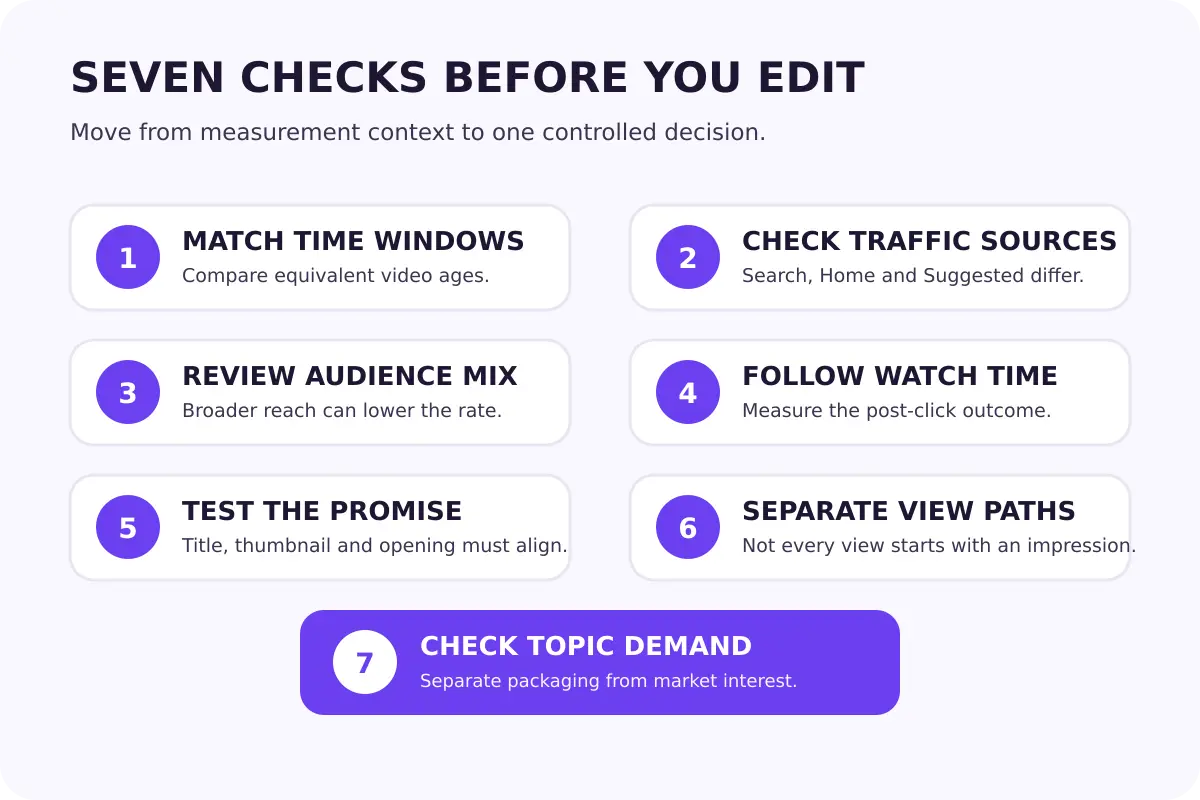
- Seven checks for rising impressions and falling CTR
- When changing the thumbnail makes sense
- A seven-day review plan
- Frequently asked questions
What the two metrics actually measure
An impression is counted when a video thumbnail is shown on a registered YouTube surface for more than one second and at least half of the thumbnail is visible. Counted locations include YouTube Search, Home, feeds, playlists and Up Next recommendations.
Some exposure is excluded. External websites and apps, email, notifications, end screens, YouTube Music and thumbnails that do not meet the visibility threshold are examples. That is why total views divided by impressions will not necessarily match the CTR displayed in Studio.
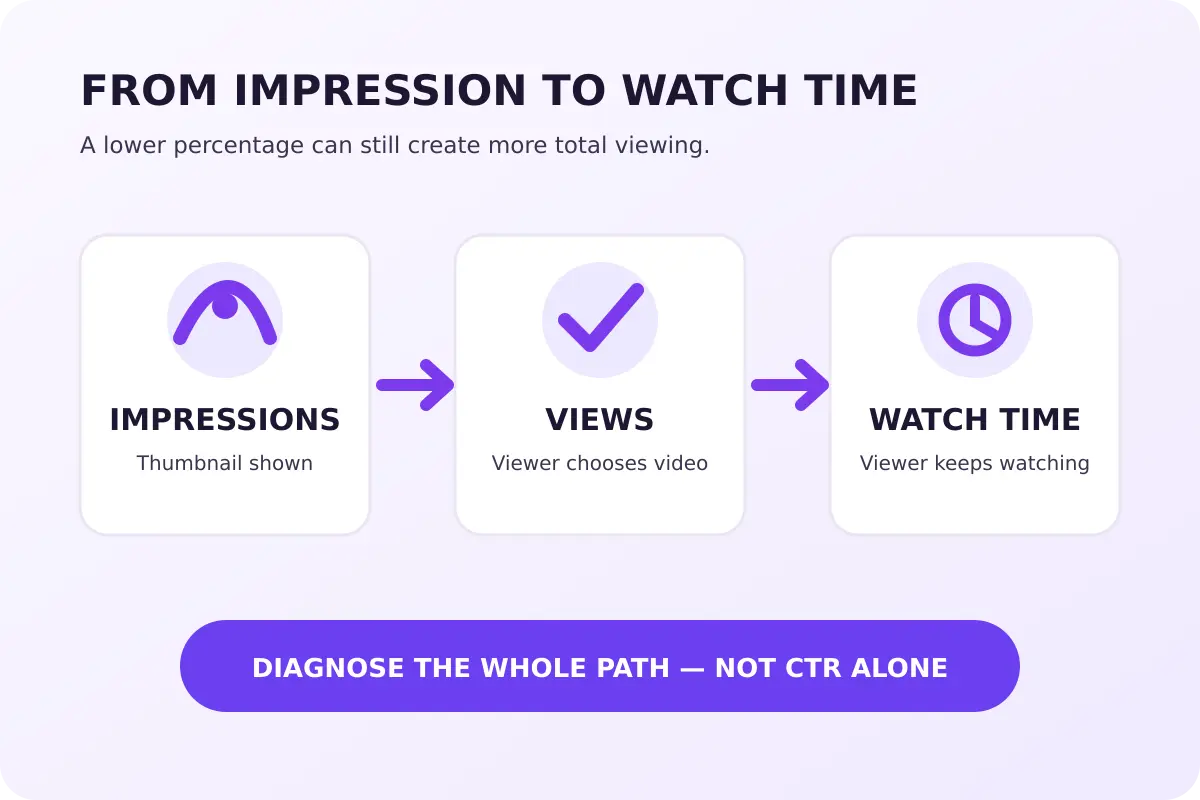
Impressions click-through rate measures how often viewers watched after seeing one of those registered thumbnail impressions. It represents a subset of the viewing journey, not a complete verdict on the video.
YouTube says half of channels and videos have an impressions CTR somewhere between 2% and 10%, but that range is not a target for every video. New channels, new uploads and videos with fewer than 100 views can fall across a much wider range. Topic, audience and traffic source all affect the number.
The better comparison is usually your own similar videos over a meaningful period. Compare tutorials with tutorials, launches with launches and evergreen search videos with other evergreen search videos. A channel-wide average can hide more than it explains.
A diagnostic table before you edit
| What changed? | Likely interpretation | What to inspect next |
|---|---|---|
| Impressions rise, CTR falls, views and watch time rise | The video may be expanding to a broader audience | Traffic-source mix and watch time from impressions |
| Impressions rise, CTR falls, views stay flat | New distribution may not be converting efficiently | Home/Suggested CTR, title-thumbnail clarity and audience fit |
| CTR falls only in a short early window | The sample may be unstable | Wait for more impressions and compare equivalent age windows |
| CTR falls after Home traffic expands | A broader, colder audience may be seeing the video | Compare Home with Search and Subscriptions separately |
| CTR falls and average view duration also weakens | The package or audience match may be off | Opening promise, title accuracy and retention |
| Total views exceed impressions | A larger share may come from uncounted surfaces | External, direct, notification and end-screen traffic |
The table is a starting point, not a scoring system. Two channels can show the same pattern for different reasons. Your job is to identify which part of the path changed first.
Seven checks for rising impressions and falling CTR
1. Match the time windows
Start by comparing like with like. A video's first 24 hours and its first seven days are different audience phases. So are a seven-day channel report and a 28-day report.
Use the same duration after publication when comparing uploads. If one video has had three weeks to reach casual viewers and another has only reached subscribers for a day, their CTRs do not describe the same situation.
Also avoid reading the metric immediately after publishing. YouTube advises waiting for a substantial number of impressions before making a decision. Early percentages can swing sharply from a small number of viewer choices.
FastSocialz practical tip: Create a simple review note for each upload at 24 hours, seven days and 28 days. Record impressions, CTR, views from impressions, watch time from impressions and the leading traffic source. The repeated windows make your comparisons cleaner.
2. Check whether the traffic-source mix changed
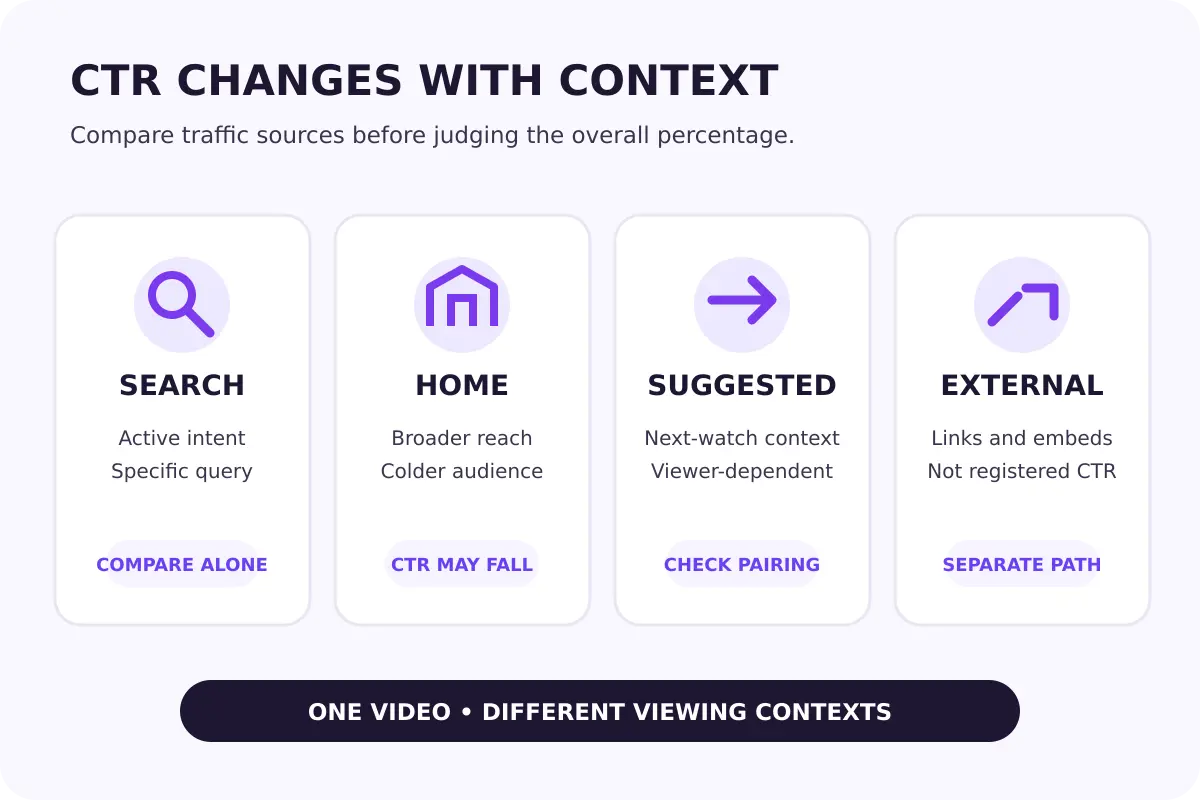
CTR depends partly on where the thumbnail appeared. A person actively searching for a precise answer is in a different state from someone scanning Home between unrelated recommendations.
If Search drove most early impressions and Home later became the largest source, the overall CTR may fall even though the video is gaining useful distribution. The title and thumbnail did not necessarily become worse; the audience context changed.
Open the video-level Reach report, then compare Browse features, Suggested videos, YouTube Search and other relevant sources. Do not combine them into one story before checking their individual patterns.
3. See whether YouTube reached beyond loyal viewers
A narrow audience of subscribers or returning viewers already knows your style. They may recognize your face, series name or visual shorthand immediately. A broader audience does not share that context.
As YouTube offers the video to more people, the percentage who choose it can decline even while the absolute number of views increases. That is not automatically a bad trade. The video may be moving from “high familiarity, small pool” to “lower familiarity, larger pool.”
Hypothetical example: A channel publishes a detailed camera tutorial. Returning viewers respond quickly, producing a strong early CTR. Two days later, Home impressions expand to people who have watched photography content but do not know the channel. CTR falls, yet views from impressions and watch time continue rising. In this scenario, changing the thumbnail immediately could interrupt healthy expansion.
Check new versus returning viewer context at channel level, then compare the video's traffic growth. Do not assume broader reach must preserve the response rate of your core audience.
4. Compare views and watch time from impressions
CTR tells you how often a registered impression led to a view. It does not tell you whether the people who clicked stayed.
Use YouTube's “Impressions and how they led to watch time” report. If impressions increase, CTR softens and watch time from impressions still rises, the video may be creating more total viewing despite the lower percentage.
If impressions rise but both views from impressions and watch time remain flat, the new exposure is adding little value. That is a stronger signal to inspect the package and audience match.
This is the key editorial distinction: a percentage can fall while the underlying outcome grows. Diagnose the outcome before optimizing the percentage.
5. Test the title-thumbnail promise against the opening
A thumbnail can attract attention and still set the wrong expectation. YouTube warns against clickbait because a high CTR paired with low average view duration can indicate that viewers did not receive what the package appeared to promise.
Read the title, look at the thumbnail and watch the first 30–60 seconds as one connected promise. Ask:
- Does the video deliver the subject shown in the thumbnail?
- Does the opening confirm the title quickly?
- Is a key object, person or result shown clearly enough to understand on mobile?
- Does the package require existing channel knowledge?
- Is the most interesting part of the video hidden behind a generic label?
A packaging problem is more convincing when the title and thumbnail are unclear and the post-click experience shows weak alignment.
6. Separate counted impressions from other views
Creators sometimes see more views than impressions and assume Studio is broken. YouTube explains that not every view begins with a registered thumbnail impression.
External embeds, websites, notifications, end screens and some app surfaces can contribute views without entering the impressions denominator. A successful newsletter mention, embedded tutorial or community share can therefore change views without moving registered impressions in the same way.
Before calculating your own CTR, use the metric already shown in Studio. Dividing total views by registered impressions mixes different traffic paths and produces a number that does not match YouTube's definition.
7. Check topic demand and competitive context
A strong package cannot create unlimited interest in a topic. YouTube says recommendation traffic can change when viewers spend more time with other videos or channels, spend less time on YouTube, or lose interest in the topic.
Look at whether similar uploads on your own channel are also slowing. Check the Trends tab for adjacent searches and content gaps. Review whether the video is seasonal, tied to a fading event or competing against a surge of new coverage.
This does not mean copying the loudest thumbnail in the feed. It means separating a presentation problem from a demand problem. If the topic is cooling, repeated thumbnail changes may move the percentage without restoring the original audience size.
When changing the thumbnail makes sense
A change is reasonable when several signals point in the same direction:
- the video has enough impressions for a stable comparison;
- CTR is materially weaker than comparable videos at the same age;
- the traffic-source mix does not explain most of the change;
- views and watch time from impressions are not growing with distribution;
- the thumbnail is unclear, misleading or visually weak on mobile;
- the title and thumbnail do not express one accurate promise.
If your channel has access, use YouTube's documented title-and-thumbnail A/B testing workflow rather than manually rotating options and comparing unequal audiences. The current tool can test up to three titles, thumbnails or combinations and uses watch time to determine the result. Our guide to YouTube dynamic thumbnails and A/B testing explains how the current test differs from newly announced personalization and video-cut tools.
Do not make three changes at once. If you replace the title, thumbnail and opening on the same day, you will not know which change affected the response.
Limitation: YouTube Analytics describes patterns; it does not prove why an individual viewer clicked or ignored a video. Treat each change as a test with context, not a universal rule.
A seven-day review plan
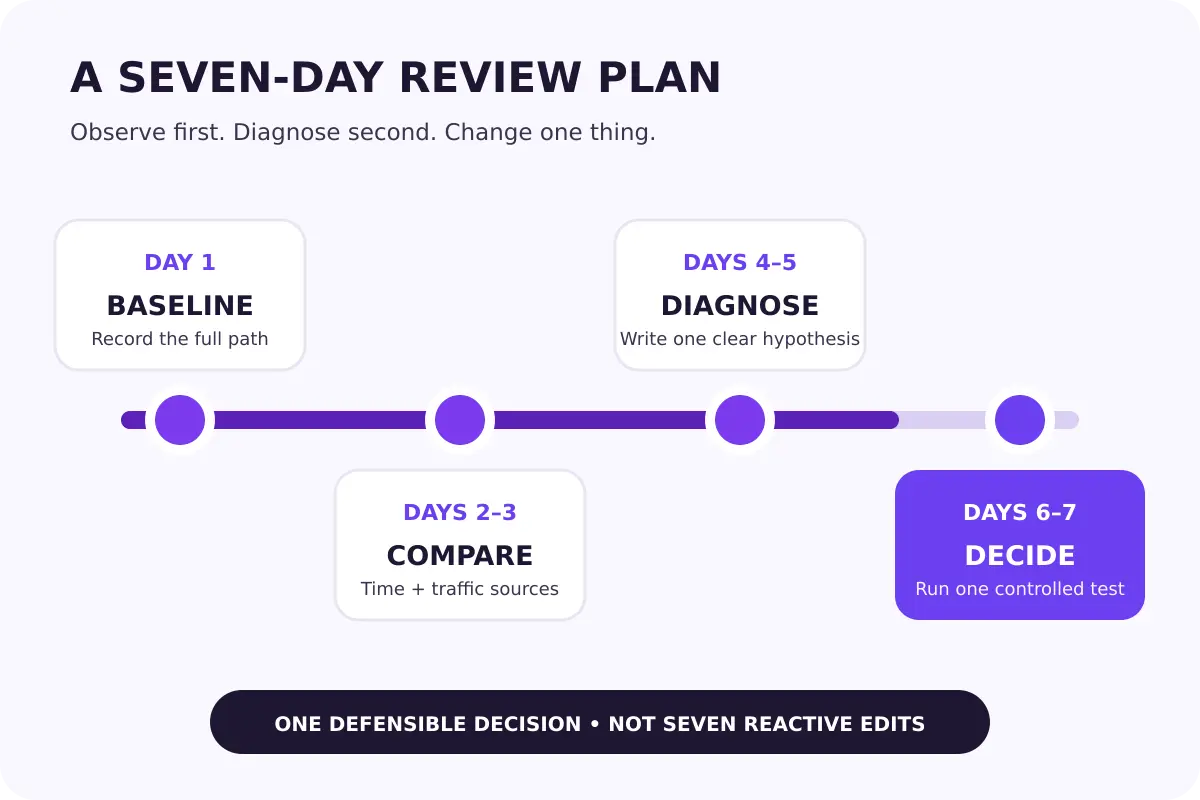
Day 1: Record the baseline. Capture impressions, CTR, views from impressions, watch time from impressions and leading traffic sources. Do not edit from a tiny sample.
Day 2: Compare the same-age window against three to five genuinely similar videos. Note topic, format and traffic-source differences.
Day 3: Inspect Search, Home and Suggested separately. Identify whether one expanding source explains the overall decline.
Day 4: Review the title, thumbnail and opening as one promise. Write down one specific weakness rather than “CTR is bad.”
Day 5: Decide whether the pattern is healthy expansion, weak conversion or unclear. If a change is justified, prepare distinct but truthful options.
Days 6–7: Start one controlled test or leave the package unchanged. Record what you changed, why you changed it and what result would count as useful evidence.
Where FastSocialz fits
Analytics can help you improve the way a video is presented, but it cannot ensure that every topic will reach a larger audience. Keep testing the content, packaging and viewing experience together.
If you want structured external promotion while you continue improving the channel itself, review the FastSocialz YouTube Growth service. It does not require your YouTube password and does not promise a particular number of views, subscribers or sales.
For related measurement context, read what changed in YouTube's 2026 public view counting.
Sources and methodology
- Check your YouTube thumbnail impressions and watch time — official definitions, counted surfaces and the impressions-to-watch-time report.
- Impressions and click-through-rate FAQs — traffic-source context, the broad 2%–10% range and cautions against early decisions.
- YouTube performance FAQ and troubleshooting — discovery signals, title-thumbnail changes and reasons recommendation traffic can vary.
This article explains YouTube's documented metrics and offers a diagnostic framework. It does not use private channel data, claim a universal benchmark or predict a particular outcome.
Final editorial takeaway
A falling CTR deserves context, not panic. If YouTube is showing the video to more people, a lower percentage can coexist with more views and more watch time. Work through the seven checks, identify which part of the path changed and make one controlled decision.
The thumbnail may need work. But the metric alone has not proved it yet.
Questions, answered plainly
Frequently asked questions
Is a falling YouTube CTR always bad?
No. CTR can fall as a video receives more impressions from a broader or less familiar audience, especially through Home. Check whether views and watch time from impressions are still growing before deciding the decline is harmful.
What is a good YouTube impressions click-through rate?
YouTube says half of channels and videos fall between 2% and 10%, but content type, audience and traffic source can create a much wider range. Compare similar videos on your own channel over equivalent time windows instead of treating one percentage as a universal target.
Why did my CTR drop after YouTube started recommending my video?
Recommendation surfaces can expose a video to people who do not already know the channel. A larger, colder audience may click at a lower rate than subscribers or returning viewers even while total views increase.
Should I change a thumbnail as soon as CTR drops?
Usually not. Wait for a meaningful number of impressions, check traffic sources and compare views and watch time from impressions. Change the thumbnail when several signals indicate a real packaging problem and you have a clear alternative to test.
Why do I have more YouTube views than impressions?
Not every view comes from a registered thumbnail impression. External websites, notifications, end screens and some YouTube surfaces can generate views without adding to the impressions count used for CTR.
Keep reading
Related guides

How to Add Chapters to YouTube Videos
A practical guide to planning, formatting, publishing, and checking YouTube chapters without turning your description into a mess.

YouTube Dynamic Thumbnails vs A/B Testing: What Creators Should Know
YouTube has announced dynamic thumbnails and video-cut testing, but its existing A/B tool works differently. Here is what each option tests and what creators can do now.

How to Use TikTok Studio Analytics: A 20-Minute Weekly Review
A focused 20-minute TikTok Studio routine for reading account trends, comparing similar posts and choosing one useful next content test.