Your song is finished. The release date is agreed. Now you need to explain the music to someone who hasn't followed the recording sessions, heard the earlier demos or read your group chat.
That's the useful job of a playlist pitch: give an editor a clear introduction to the song. You don't need to describe it as the next global hit. You need accurate details, a believable story and enough time to submit before release.
This guide walks through preparing and submitting a song pitch in Spotify for Artists. It covers audio releases, not the separate music-video pitching process. You'll finish with a short brief you can review with your team and a checklist for the submission itself.
What a pitch can and cannot do
Spotify's current pitching guidance lets Admins and Editors submit an upcoming, unreleased song through Music → Upcoming. You can pitch one song at a time; another becomes possible after that song is released. Compilations and songs on which you're a featured artist aren't eligible for this song-pitch route.
Submission is consideration, not a booking. A strong release plan should still make sense if an editorial playlist doesn't select the song. That means preparing your own communication, checking your public links and deciding what you'll learn after launch.
Don't confuse a pitch with distribution. Your distributor or label delivers the music. The pitch supplies context for editorial consideration after the release is available in the artist workspace.
Before you start: make a small release folder
Keep the final title, release date, artist details, a listening copy and your factual release notes together. Use one working document rather than several slightly different descriptions across messages.
Spotify's Upcoming documentation says delivered music can take around 48 hours to appear. If it is missing, check with your distributor that it was sent to the correct artist profile. Release details shown there include artwork, tracklist and date; corrections go through the label or distributor.
Build some breathing room into your own schedule. Delivery, checking and writing are separate tasks. Planning to do all three during the final evening leaves little room to fix an unexpected problem.
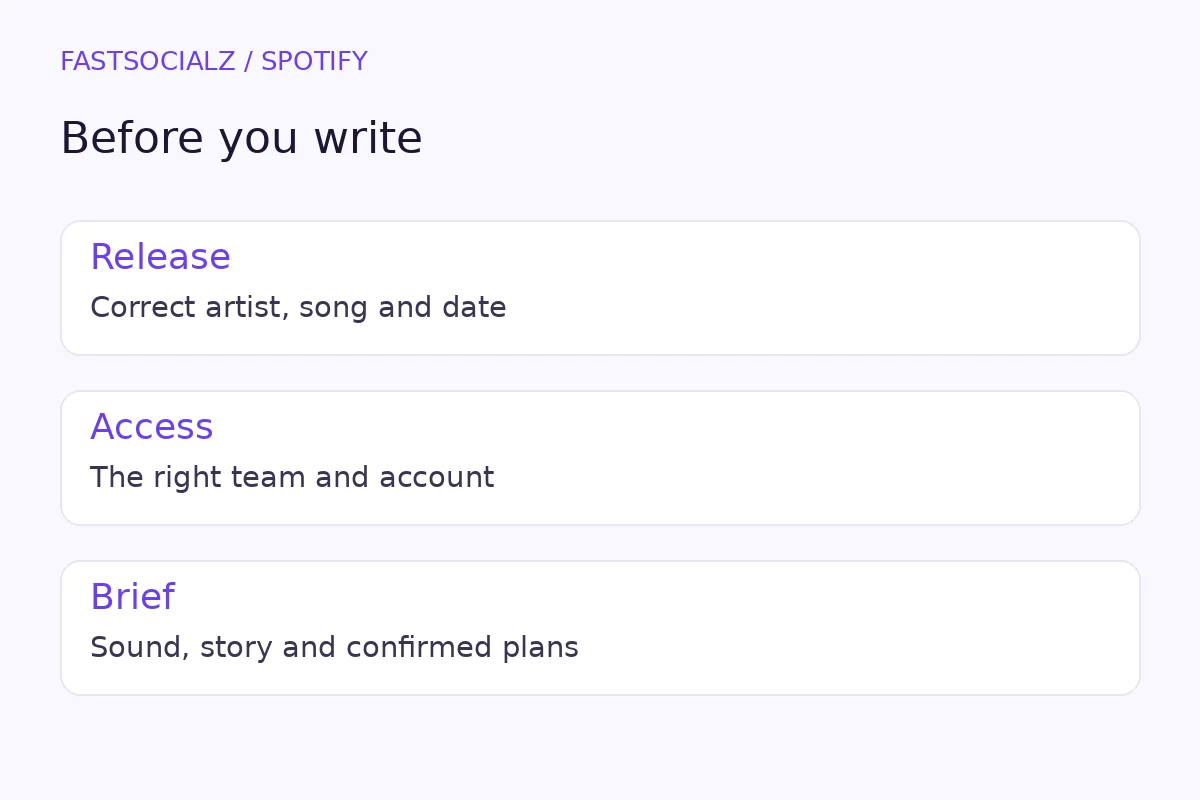
| Prepare | Why it helps | Who should confirm it |
|---|---|---|
| Correct artist and song | Prevents a pitch for the wrong release | Artist or manager |
| Confirmed release date | Keeps the plan tied to actual availability | Distributor or label |
| Short musical description | Makes the sound understandable | Artist and producer |
| Factual story and plans | Separates real context from promotional language | Team member responsible |
| Final reviewer | Prevents contradictory last-minute edits | One named person on your team |
The final row is a workflow recommendation, not a Spotify account role. Even a solo artist can benefit from deciding which version of the brief is final.
1. Check the release before writing the pitch
Open Spotify for Artists, select the correct artist and look under Music, then Upcoming. Check the song title and release details against your own delivery record before doing anything creative with the description.
If something doesn't match, pause the submission and establish which record is correct. An elegant pitch won't repair an incorrect release date. Ask the person who manages distribution to resolve the delivery details, then check the artist workspace again.
The date can also need interpretation. Spotify explains that Upcoming reflects the earliest availability date, which can differ from your local calendar date. If the timing looks strange, ask your distributor to confirm the release time and territory settings rather than guessing.
Team tip: Put the confirmed release date and the date you checked it at the top of your working document. This gives everyone a shared reference when discussing deadlines.
2. Choose the song you can explain clearly
If you're releasing several tracks, write a one-sentence description of each candidate before choosing. This is a useful editorial exercise, not a formula for predicting playlist selection.
Listen for what distinguishes the track: the instrumentation, vocal delivery, pace, emotional setting or a change in the arrangement. Which details would help an unfamiliar person understand what they are about to hear?
Avoid selecting a song solely because somebody has promised it is “playlist friendly.” That label doesn't tell you which listeners it suits or what makes the recording specific. Your team should be able to explain its choice without relying on an imagined guarantee.
You may choose the track that best represents the release, the one your launch materials already support, or the song with the clearest individual story. Those are planning reasons. They aren't claims about Spotify's ranking system.
3. Draft the musical description first
Start with the sound. Write a plain sentence about the core musical character, then a sentence about an element that makes the recording distinctive. Keep the language understandable to someone outside your immediate scene.
Compare these two hypothetical descriptions:
“An incredible, genre-defying song that everyone will love” gives the reader almost nothing to work with.
“A restrained electronic pop track built around a close vocal and a dry drum pattern; the final chorus opens into layered harmonies” describes something a listener can actually check.
The second is still only an illustrative example. Use details from your recording, not its wording. If the song doesn't have layered harmonies, don't add them because the sentence sounds polished.
After drafting, play the track again. Underline every adjective in your description and ask whether it points to an audible quality or merely expresses excitement. Keep the useful ones. You can love the song without asking the editor to accept your enthusiasm as evidence.
4. Add the story and confirmed release activity
Explain the context that changes how someone understands the music. Perhaps the lyric explores a particular situation, the recording marks a deliberate change in direction, or a collaboration shaped the arrangement. Keep the story proportionate to the space available.
Spotify's editor Q&A discusses the value of release context and information such as video, promotion and release plans. It doesn't turn those activities into a checklist of compulsory achievements.
Separate confirmed plans from possibilities. “A performance video is scheduled” and “we're considering making a video” are different statements. Don't claim press coverage because you've sent a press email, or call a proposed show a confirmed tour date.
An explicitly hypothetical independent duo might have a finished performance clip and two confirmed local shows, but no press coverage. Their useful brief would state those facts. It wouldn't need an invented publication quote to make the release sound important.
If there isn't a dramatic backstory, write honestly about the song. A small, specific detail can be more informative than a long account of how passionate the artist has always been about music.
5. Complete the form and review the whole submission
Return to the selected upcoming song and complete the pitch form. Use the categories and fields currently presented in your account. Keep those choices consistent with the description rather than trying to attach every possible label.
Read the whole submission once as a person encountering the release for the first time. Does the story match the sound? Are names spelled correctly? Do the plans distinguish what is booked from what is hoped for? Have you accidentally pasted a description of a different track?
Spotify recommends delivery at least seven days before release. Its song-pitch guidance also ties submission at least seven days ahead to followers' Release Radar. That is distinct from editorial playlist selection and should not be presented as a promise of streams or audience growth.
Plan around that seven-day lead time, but start preparing earlier if you can. Give yourself additional time for delivery checks and team review where your release schedule allows it.
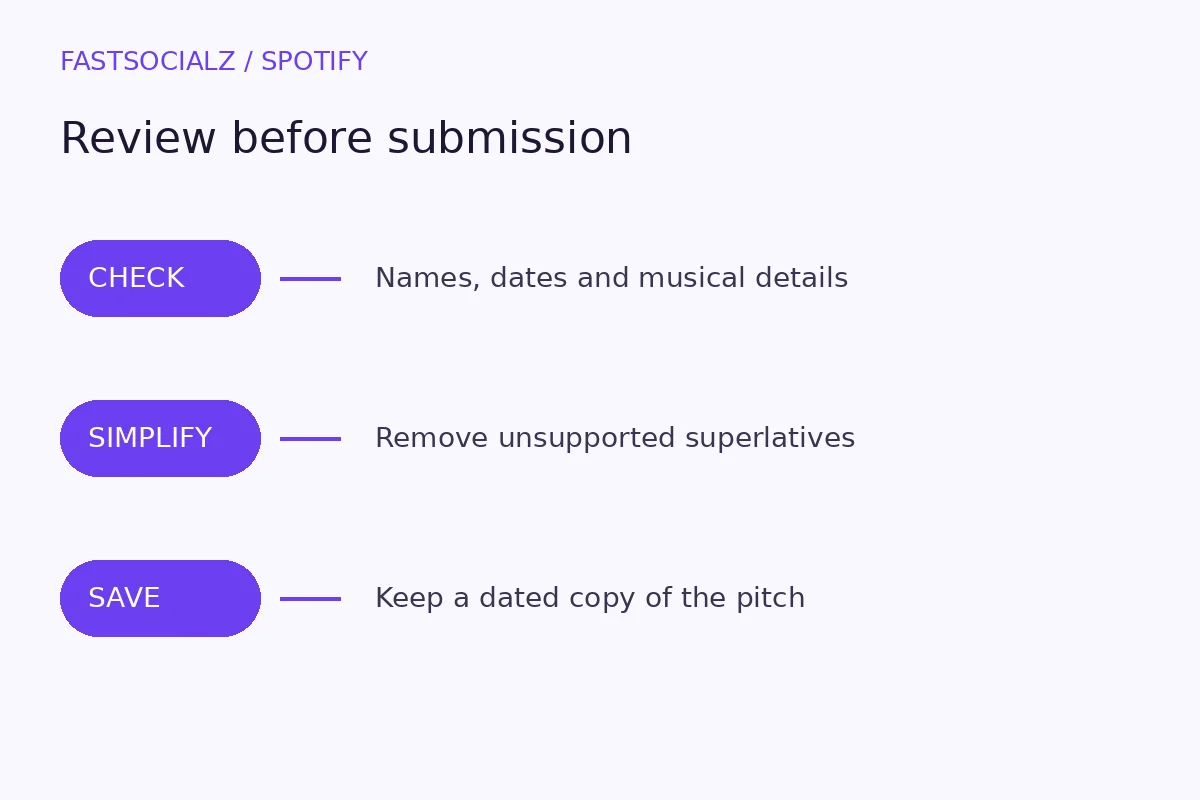
Once submitted, keep a dated copy of the brief and note who completed it. Spotify permits changes up to release day, but says editors may not see later edits. Make the first version accurate instead of depending on a final-hour rewrite.
A simple brief you can adapt
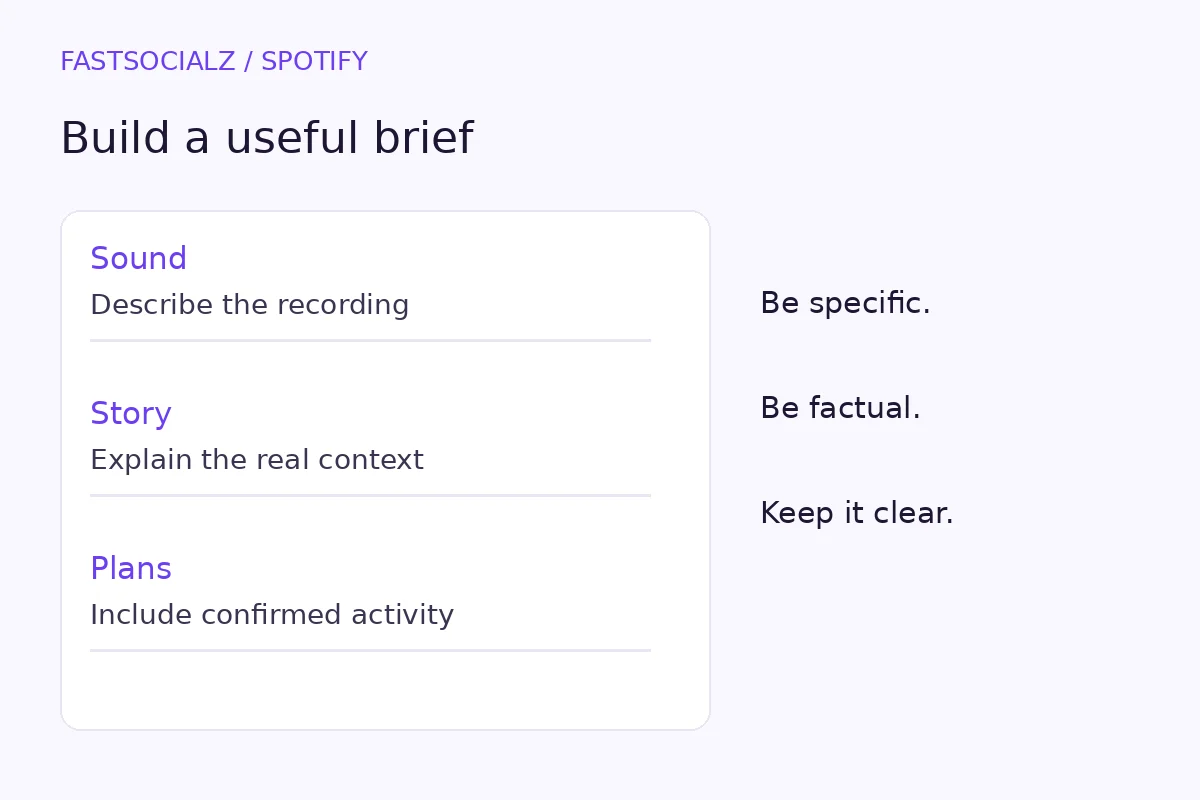
Use this structure as a private writing aid, not as a script that every artist must follow:
- Sound: What will an editor hear first, and what changes as the song develops?
- Story: What specific context helps explain the song?
- Release activity: Which relevant plans are actually confirmed?
- Final check: Are the details accurate and consistent with the release?
For a hypothetical acoustic songwriter, the sound might centre on fingerpicked guitar and an intimate vocal. The story might concern returning to a hometown. If a live session is genuinely booked, that can be included as a plan. None of this requires claiming that the artist already has a large audience.
Don't paste private contact details, unrelated personal history or a long biography just to fill space. The goal is to make the song easier to understand, not to include everything you know about the artist.
What usually goes wrong
The release is missing
Check delivery status and artist mapping with the distributor. Allow for the documented processing time. Repeatedly rewriting the pitch won't solve a release that hasn't reached the correct workspace.
The song has already been released
The unreleased-song route is no longer available for that song. Concentrate on the release activity you can still control and plan the next submission earlier. Don't take down and reupload music solely to chase another pitch opportunity.
Different people keep changing the description
Agree on one working version and one final reviewer. Team members can contribute factual corrections, but avoid parallel rewrites that leave conflicting information in the final submission.
The pitch sounds like an advertisement
Replace superlatives with details. Remove unsupported audience claims and borrowed praise. Read it out loud: if you wouldn't naturally say the sentence to somebody asking about the song, simplify it.
Nothing is selected immediately
A submission is not a selection notice. Don't interpret the absence of placement as a technical fault or a judgment on the entire project. Keep the rest of your release plan moving.
After release: review without rewriting the story
Keep your original brief so you can compare the plan with what actually happened. Record which activities took place, which were cancelled and what questions remain. Avoid retrospectively describing every positive movement as proof that the pitch worked.
For interpreting a changing headline audience figure, use our monthly-listener diagnostic. Building a longer relationship with listeners is a separate task covered in our listener-to-follower guide.
Before your next release, carry forward one practical improvement: earlier delivery confirmation, a clearer musical description or a better internal review process. You don't need to replace the entire strategy after one outcome.
Final submission checklist
Check the correct artist, unreleased song and release date. Confirm the sound description, factual story and actual promotion plans. Have one person review the complete submission, submit with adequate lead time, and save a dated copy.
If you're considering paid promotion alongside this work, review FastSocialz's Spotify growth page as a separate commercial decision. Ask how the methods work and whether they comply with Spotify's rules. A third-party service is not the editorial submission tool and should not be treated as a promise of playlist selection or audience results.
Frequently asked questions
Can I pitch a song after release?
Not through Spotify's unreleased-song pitching route. Plan the submission while the song is still upcoming.
Can I pitch several songs at once?
Spotify allows one song pitch at a time. Once that pitched song is released, you can pitch another.
Does a pitch guarantee an editorial playlist placement?
No. Submitting gives the release consideration; it doesn't reserve a placement or promise streams.
What should I write if I have no press coverage?
Describe the music and its real context. Include only activities and achievements you can substantiate; don't invent coverage to fill the space.
Leave the editor with a clear picture
A useful pitch makes the music understandable without exaggerating it. Prepare early, check the release details and explain the song in language you can stand behind. Then let the rest of your release plan do its own job.
Written by the FastSocialz Editorial Team. Official guidance checked on 18 November 2026. All illustrative scenarios are hypothetical.