
You open your artist profile and the listener count is lower again. Yesterday's post went out, your music is still available, and people are still sharing it. So what changed?
A falling number deserves a closer look, but it doesn't explain itself. Before changing your release plan or spending more on promotion, separate the reporting window from the listening behaviour behind it. This guide is for music artists and their teams, not podcast analytics.
Quick answer
Spotify monthly listeners measures the people who listened during the last 28 days. That moving window can lose earlier listeners while your music continues receiving plays. Check the dates, individual songs, listening sources and audience segments before deciding whether the decline reflects a reporting mismatch, reduced discovery or less intentional listening.
Key takeaways
- A listener count is not a lifetime total or a follower count.
- Compare equivalent reporting periods before interpreting a change.
- Find the song and source associated with the decline.
- Look beyond the headline number to understand intentional listening.
- A drop alone doesn't prove a penalty or an algorithm change.
Start with a question you can actually answer
“Why is my career going backwards?” is too broad for a dashboard. “Which song lost listeners in the same reporting period?” is something you can investigate.
Write down the metric, where you saw it, the date and the comparison you're making. Keep that note beside your release and promotion calendar. You want enough context to explain the change later, without relying on a screenshot of one large number.
Spotify's listener and follower definitions distinguish unique listeners during a selected period from people who follow an artist profile. Overall audience figures and individual release figures also answer different questions. Don't substitute one for another just because they appear near each other.
Our Spotify listener-to-follower guide covers the separate task of encouraging a longer relationship with listeners. Here, the first job is to understand what changed.
A diagnostic table for the first review
| What you notice | What to inspect | What it does not prove |
|---|---|---|
| A decline several weeks after a spike | Dates of the earlier listening activity | Everyone recently stopped listening |
| One release accounts for most of the change | That release's listening sources | The entire catalogue has weakened |
| Public and private figures differ | Definitions, timestamps and dashboard notices | Someone has manipulated your account |
| Fewer listeners but continued streams | Comparable period and repeat listening | Every listener is becoming more engaged |
| A promotion ended before the decline | Campaign dates and relevant source changes | The promotion caused every change |
These are investigation prompts, not automated diagnoses. Several explanations can be true at once. An earlier burst of discovery can age out of the window while another song attracts a smaller group of repeat listeners.
1. Understand what leaves the 28-day window
Spotify's audience-segment documentation defines monthly listeners as listeners in the past 28 days, including active and programmed listening. The window moves; it isn't a calendar-month score that resets on the first day.
Consider an explicitly hypothetical example. A listener discovers your track during a weekend promotion, plays it, and doesn't return during the following weeks. Eventually, that earlier activity no longer sits inside the current window. Their departure from the count does not mean they unfollowed you today.
That's why timing matters. Look back to when the count began rising, not only to the day it started falling. Was there a release, performance, interview or promotion around that earlier period? Add the dates to your notes, then check whether the listening data supports the connection.
Don't simply label every decline “normal.” The window explains how a count can change, not whether your present activity is working. You still need to inspect what is entering the window as older activity leaves it.
FastSocialz practical tip: Keep a dated activity log with one line per release or promotion. A short factual record is more useful than trying to remember which post seemed successful four weeks ago.
2. Match the reporting period and update timing
A live release counter and a daily audience report don't necessarily describe the same moment. Spotify says its regular artist statistics update daily and use UTC dates. It also provides a live stream counter during a new release's first seven days. Those are different reporting tools.
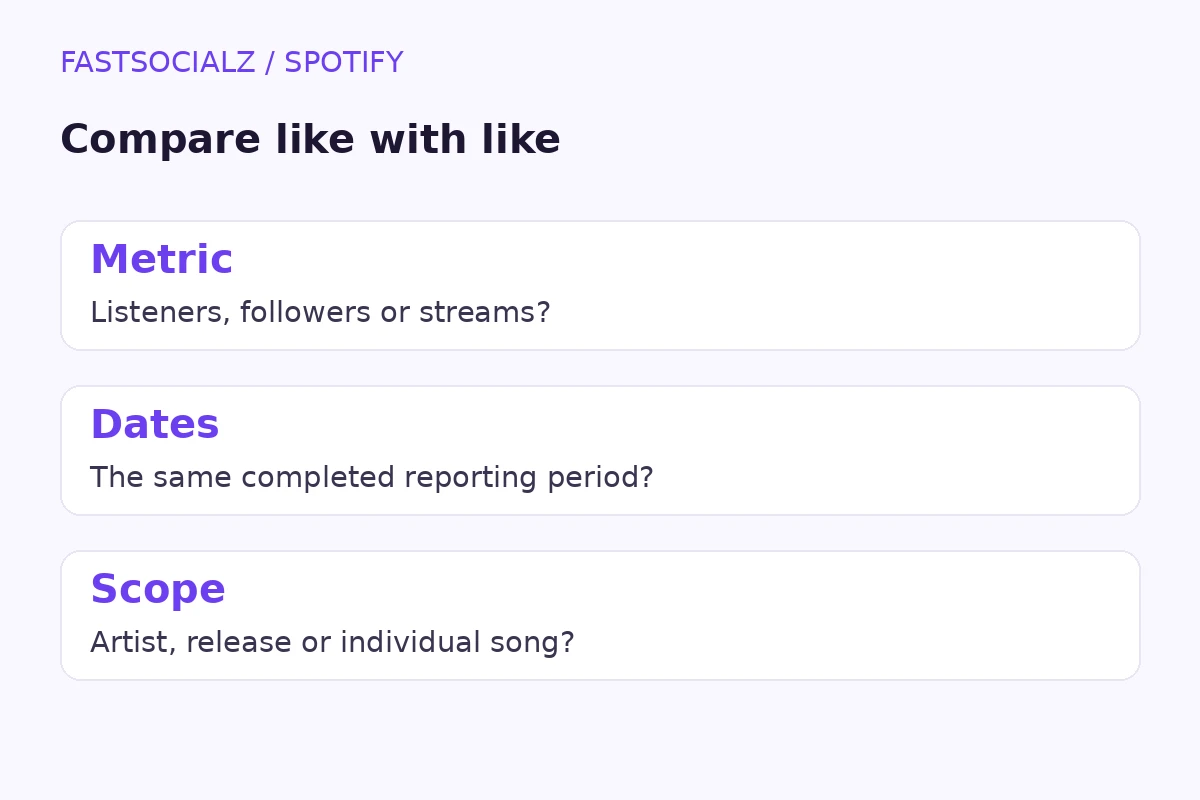
Before comparing two figures, check the selected dates and whether both cover the same artist, release or song. If the most recent reporting day is incomplete, mark it as incomplete rather than treating it as a finished result.
For an explicitly hypothetical scenario, an artist posts a release link late in the evening in Dubai. A teammate reviews the figures using local calendar dates, while the dashboard uses UTC. Their notes can place the activity on different days even though they're discussing the same campaign. Align the dates before debating the creative.
Avoid refreshing repeatedly in the hope that it will settle the question. Save one dated observation, allow the normal reporting update, and compare again. If the discrepancy persists, preserve both views and their labels so support can understand the issue.
3. Find the song behind the artist-level change
Your public artist number compresses a catalogue into one figure. Start with the releases that contributed most to the earlier increase and review their current activity over comparable periods.
One older song may have received a temporary burst of attention. Another may be maintaining a smaller but steadier audience. Treating both as a single marketing problem can lead you to change the wrong thing.
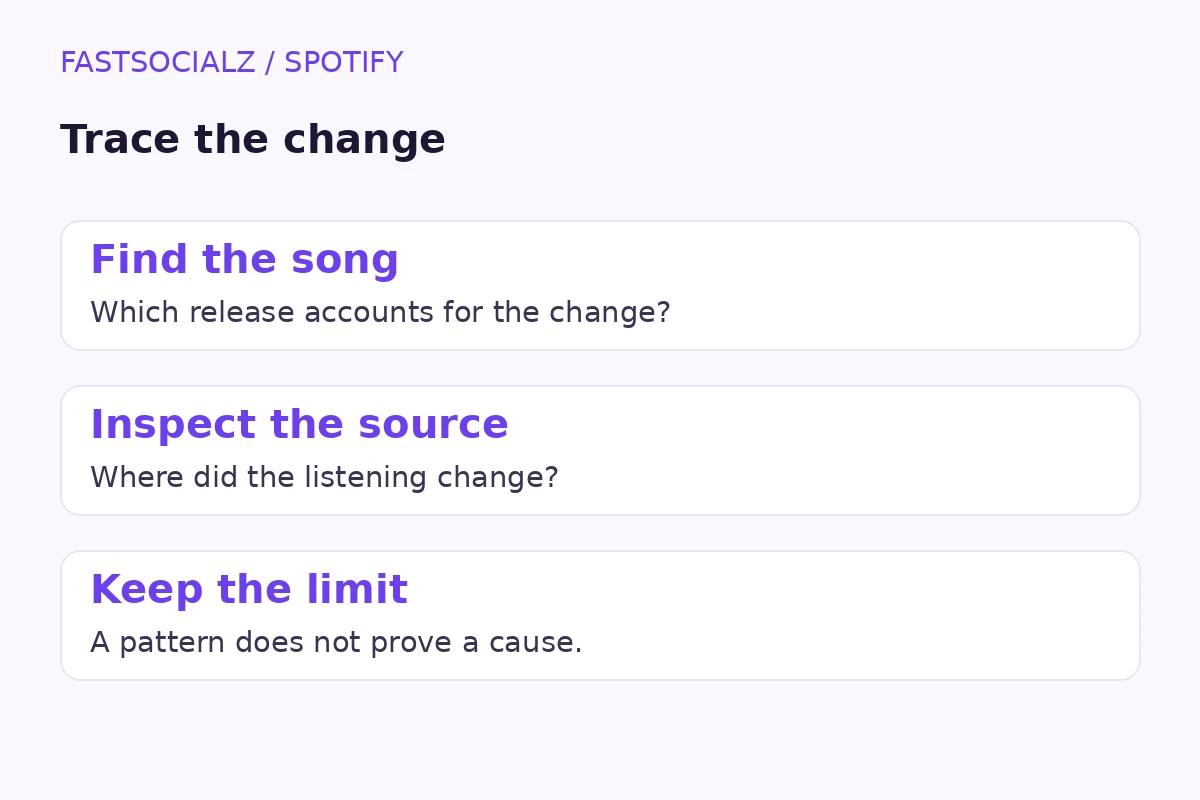
Make a short working table: song, comparison dates, observed change and relevant activity. Leave the explanation blank until you've inspected the evidence. “The song lost discovery traffic” is a hypothesis; “the source report shows fewer listeners from this category during these dates” is an observation.
Do not add listener totals across songs and call the sum your unique artist audience. One person can listen to several songs. The same caution applies to reading a catalogue as though every release has a completely separate audience.
You don't need to analyse every track at once. Begin with the largest visible change, establish a plausible explanation, and then check whether it also fits the rest of the catalogue. If it doesn't, keep the explanations separate.
4. Inspect sources without turning correlation into certainty
Spotify's source-of-streams report separates active sources, where listeners intentionally seek music, from programmed sources, where Spotify or another listener selects it. Compatible filters let you examine a time period, country and metric.
That breakdown helps you ask a better question. Did the decline appear mainly in discovery-oriented listening, or did listening from places such as your profile and listeners' own libraries also change?
In an explicitly hypothetical scenario, a song receives attention through another listener's playlist. Later, the artist sees less activity from that source category. It is reasonable to investigate playlist-related exposure. It isn't enough to claim that Spotify has suppressed the artist, or that one specific playlist explains the entire decline.
Use the available detail, then stop where the evidence stops. A dashboard category cannot tell you every person's motive. Nor does a matching date prove that your last social post caused the result.
Spotify also warns that listener subtotals across sources can exceed the overall listener count because one person can use several sources. Keep that overlap in mind before building a spreadsheet total that appears to disagree with the dashboard.
5. Separate discovery from intentional listening
The monthly active listener segment is narrower than the headline monthly listener count: it concerns intentional listening from active sources over the past 28 days. Review it alongside the broader audience rather than treating the two labels as interchangeable.
This distinction changes the practical question. A decline in broad discovery may call for reviewing how new people find the music. A decline in intentional listening may prompt you to examine whether your ongoing communication gives interested people a clear reason to return. Neither interpretation is a guaranteed explanation; it is a direction for investigation.
A smaller audience isn't automatically a stronger one. Likewise, a larger audience isn't automatically less interested. Avoid turning a convenient story into a conclusion before checking the actual pattern.
If you compare streams per listener, keep the period and scope consistent. An average can be shaped by a small group of frequent listeners. It doesn't mean each person listened that many times, and it doesn't identify which listeners will become long-term fans.
FastSocialz practical tip: Write two separate notes: “What changed in discovery?” and “What changed in intentional listening?” If the evidence answers only one, leave the other open. That uncertainty is useful information.
6. Check notices before assuming a penalty
A chart alone cannot establish that Spotify penalised your music. Look for actual messages in Spotify for Artists and relevant communication from your distributor or label. Record what the notice says, which release it concerns and the dates involved.
Spotify explains that confirmed artificial streaming can lead to adjusted public metrics, while private dashboard data may sometimes differ. This is one documented explanation for certain discrepancies, not an accusation about every artist whose count falls.
If something looks suspicious, keep the playlist links, campaign details and screenshots. Use Spotify's reporting route or work with your distributor as appropriate. Avoid making public allegations based only on unfamiliar geography or a sudden spike.
Promotion limitation: Spotify says paid services promising streams or guaranteed playlist placement violate its terms. Don't respond to a disappointing count by buying a promised number. Ask any provider how promotion works and what it can actually demonstrate before committing money.
Make one evidence-based change this week
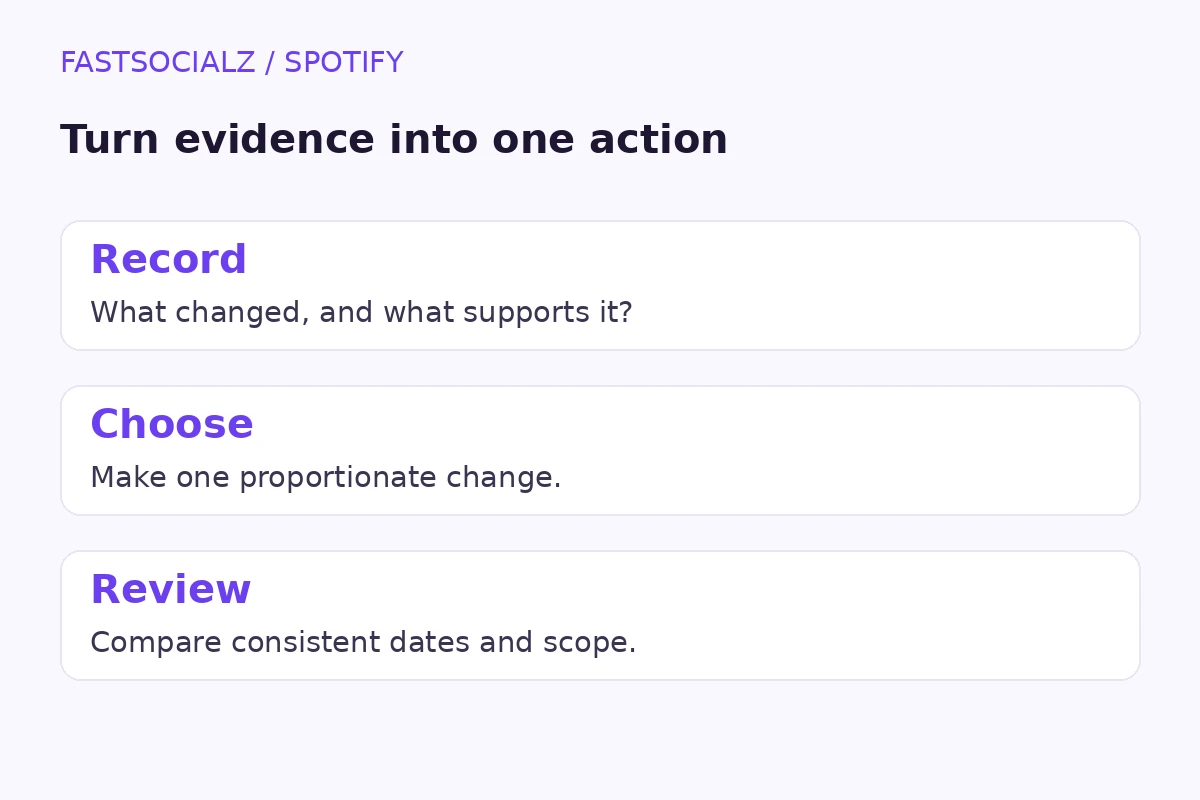
Finish the review with a short statement: what changed, what evidence supports the explanation and what remains unknown. If you can't write that clearly, the next step is usually better measurement rather than a larger campaign.
Choose one action that fits the finding. If the earlier spike explains much of the movement, keep monitoring the current baseline. If a particular source weakened, review the activity associated with that source. If a reporting discrepancy remains unresolved, assemble a support request instead of redesigning the release campaign.
For communication changes, make the listener's next step clear. Send people to the music you're discussing, explain why that track matters and avoid asking for several unrelated actions at once. This is an editorial recommendation, not an algorithm formula.
Keep the observation period consistent and write down the date of your change. A seven-day review can help organise your work, but it doesn't guarantee that the effect will be measurable within a week. Don't interpret a short test as a reliable forecast of your career.
If you're considering external promotion, review FastSocialz's Spotify growth page as a separate commercial decision. Ask about methods and Spotify compliance; a service description does not replace that check or promise a particular audience outcome.
Frequently asked questions
Can monthly listeners fall while streams continue?
Yes. Listeners and streams answer different questions, and an earlier listener can leave the moving reporting window while other people continue playing your music.
Does a falling listener count mean people unfollowed me?
No. Followers are a separate measure. The listener count alone cannot establish whether anyone unfollowed your artist profile.
Should I release another song immediately to fix a drop?
The count alone isn't a reason to rush a release. First identify the relevant dates, songs and sources, then decide whether a change to your release plan is justified.
Does a decline prove an algorithm penalty?
No. Look for specific platform or distributor notices and supporting evidence. A falling chart by itself doesn't establish a penalty.
Keep the number in its proper place
Monthly listeners is useful context, but it cannot explain a whole audience relationship. Find the scope of the change, compare like with like and choose a response you can explain without guessing.
This diagnostic guide was checked against Spotify's official documentation on 17 November 2026. All scenarios are hypothetical; no campaign study or universal benchmark is claimed. For more platform-specific guides, browse the FastSocialz blog.
Written by the FastSocialz Editorial Team.