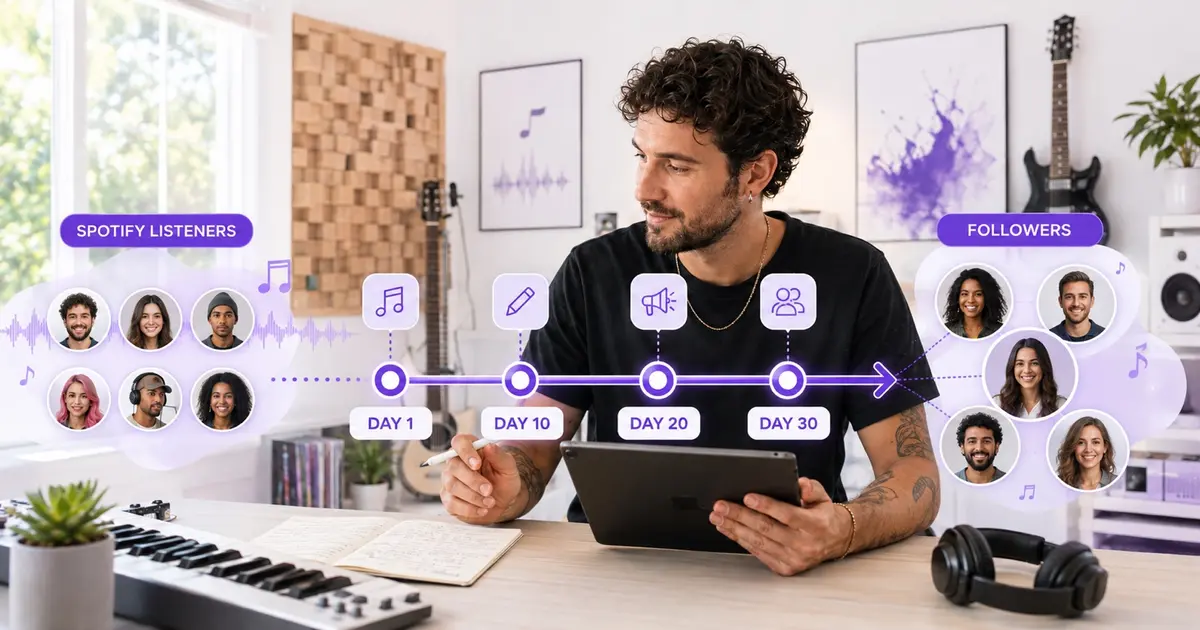
A playlist placement can make your monthly-listener number jump overnight. It feels great—until the placement cools and much of that audience disappears with it. That doesn’t automatically mean the campaign failed. One person heard a track; a follower chose to keep the artist within reach.
Your job is to make that second choice easy. You need a profile worth exploring, a reason to return and a simple route back to Spotify—not a desperate “follow me everywhere” message or a made-up conversion benchmark.
TL;DR
Why listeners don’t automatically become followers
Spotify separates listeners from followers for a reason. A listener streamed your music during the selected period; a follower actively followed your artist profile. Spotify reports that, on average, people are three times more likely to stream an artist during the next six months after following. Followers can also encounter new music through Release Radar and What’s New.
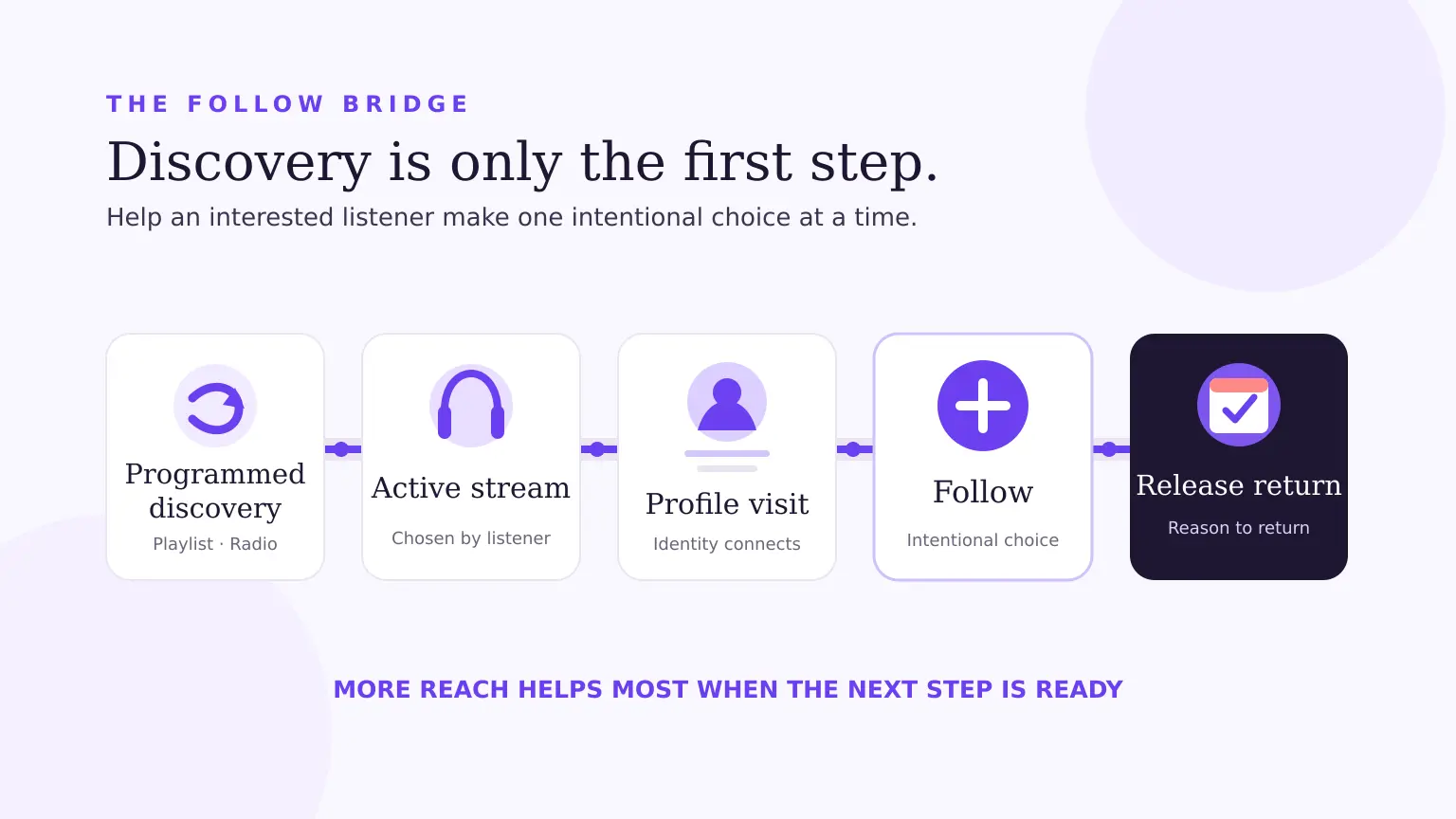
Imagine someone hearing your song halfway through a large mood playlist. They like it, but they’re cooking, driving or working. The track ends and the playlist continues. They may never see your profile, learn your name or understand what to expect next.
Discovery happened, but recognition didn’t.
Spotify for Artists shows part of that gap through source of streams:
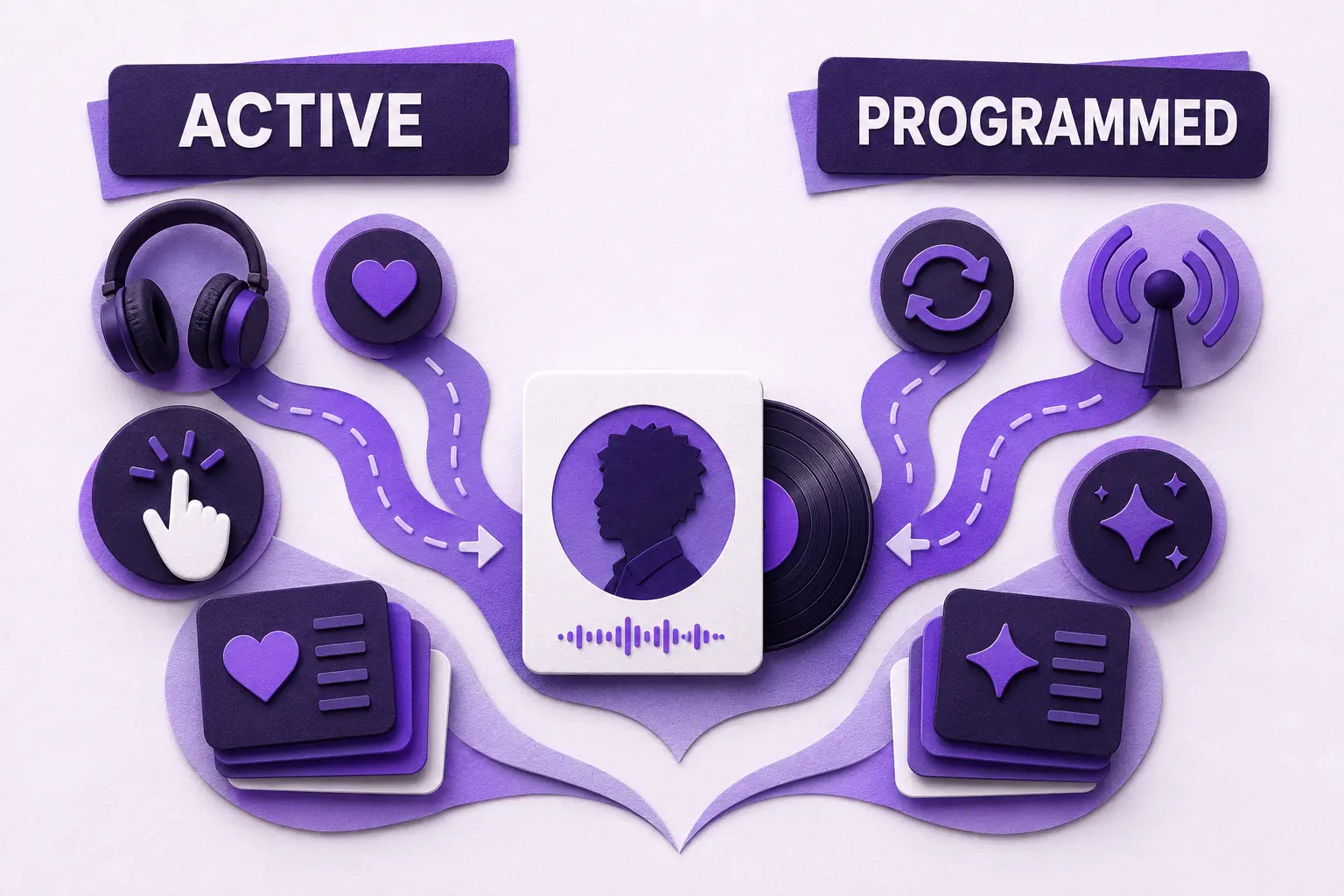
- Active sources: the listener intentionally found your music through your profile, catalog, their own library, a personal playlist or their queue.
- Programmed sources: Spotify or another listener selected the music through editorial playlists, algorithmic playlists, Radio, Autoplay or someone else’s playlist.
Programmed discovery is useful, but it doesn’t prove people remember you. The plan is to help interested listeners take one intentional next step.
What you need before starting
You need Spotify for Artists access, a 28-day baseline and one upcoming reason for people to care.
Before day one, collect these numbers:
| Baseline | What it tells you |
|---|---|
| Monthly listeners | How many unique listeners played your music in the last 28 days |
| Followers | How many people currently follow the artist profile |
| Active vs programmed sources | Whether listening was intentional or selected for the listener |
| Artist profile and catalog streams | Whether people deliberately reached your artist space |
| Listeners’ playlists and library | Whether your music is becoming part of personal listening habits |
Write the date beside every number and compare matching ranges. Then choose one focus: a forthcoming single, a recent track, an artist playlist or a live date. “Follow for more” is vague. “Follow before Friday’s acoustic release” gives the listener a reason and a moment.
Step 1: Find the point where attention is leaking
Open Spotify for Artists and review Audience → Segments and Source of Streams. Don’t begin with your follower-to-listener percentage. There isn’t one universal healthy number for every artist, genre, market and campaign.
If programmed streams rose after a playlist placement but artist-profile activity barely moved, your discovery did not create much curiosity. If streams from listeners’ own playlists and libraries are rising, people are making more deliberate choices around the music. If profile/catalog streams move but followers remain flat, the profile or follow message may be the weak point.
Spotify’s audience segments make the distinction clearer. Monthly active listeners intentionally streamed your music during the last 28 days; programmed listeners heard you only through programmed sources. Your aim isn’t to make every passive listener follow. It’s to help interested listeners move toward intentional listening.
Record the baseline in a simple sheet. Leave room for a note about what happened that week—playlist inclusion, a social post, a release, a press mention or nothing unusual. Context keeps you from crediting the wrong activity later.
Step 2: Make your artist profile answer “Why follow?”
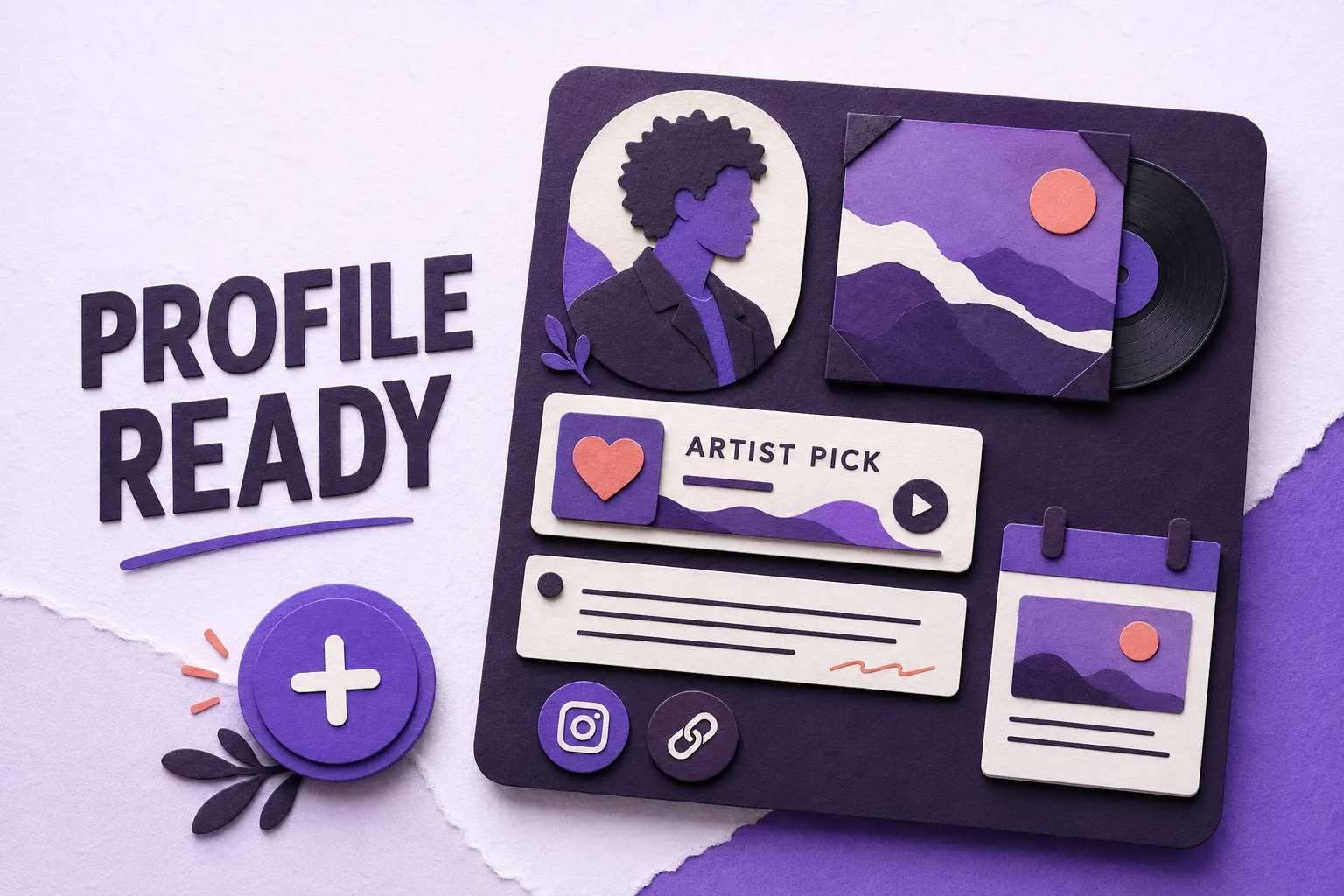
View the profile like a listener who knows one song and nothing else. Does the artist image match the project now? Does the bio quickly explain the sound? Is the most relevant music easy to find?
Spotify’s Artist Pick sits at the top of the profile and can feature music, a playlist, concerts, merchandise or selected podcast content. You can add a short message and image, and the Pick can remain visible for up to 180 days unless you change it sooner. Use it as an editorial signpost, not permanent furniture.
A useful Artist Pick message is specific:
- “Start here: our newest single and the story behind it.”
- “The three songs that introduce this project.”
- “New EP arrives Friday—follow to keep it close.”
Add only social links that help a curious listener understand you. A dead account creates more friction than no link. And keep the profile consistent with the music earning attention now.
Step 3: Build one clear follow bridge
For the next two weeks, connect your strongest content to one Spotify destination and one simple message. For example:
- A short video about the lyric → the track → “Follow on Spotify for the next chapter.”
- A studio clip → the Artist Pick → “Follow before the full version arrives.”
- A three-song introduction → an artist playlist → “If this is your kind of late-night sound, follow the profile.”
Match the wording to the audience. A music supervisor may care about catalog depth; a casual short-video viewer may need a faster emotional reason. When a post is about one song, link to that song. When it introduces the artist’s world, link to the profile. Ask for one action—not a follow, save, share, comment and email signup together.
Step 4: Give the follow a future payoff
People follow because they expect something later. Build that expectation into your release communication.
Spotify says Release Radar updates every Friday, and followers receive songs from your new release there. Pitch at least seven days before release if you want to choose the track used for followers’ Release Radar; deliver the music at least seven days early for first-week eligibility.
So work backward from release day:
- Deliver and pitch the release with enough time.
- Update the profile and Artist Pick before promotional traffic arrives.
- Explain what is coming and when.
- Ask interested listeners to follow so the next release is easier to find.
Don’t promise that every follower will stream the new track, or that following guarantees a particular placement. The honest benefit is continuity: following gives Spotify another way to reconnect listeners with an artist they chose.
Step 5: Repeat the message without repeating the post
During week three, try four angles:
- The origin: where the track began.
- The detail: one lyric, instrument or production choice people may have missed.
- The identity: who the music is for or what world it belongs to.
- The future: what followers can expect next.
Keep the link and desired action consistent while the creative changes. If one angle starts conversations, explore it. If another earns clicks but no deeper Spotify activity, check whether the destination matches the promise.
Step 6: Review movement, not just totals
At the end of each week, look for a connected pattern:
- Did artist-profile and catalog streams increase?
- Did listeners’ playlists and library become a larger source?
- Did monthly active listeners move differently from programmed listeners?
- Did follower growth happen near a specific message, release moment or profile change?
One playlist can swell monthly listeners and distort every ratio. A quiet week can make a small gain look unusually strong. You’re not trying to prove that one post caused every follow; you’re looking for repeatable evidence of more intentional behavior.
A realistic example: the playlist spike that didn’t stick
Consider a hypothetical electronic artist whose track enters a focus playlist. Monthly listeners climb, but followers barely move. The source report shows a programmed lift; the profile still features last year’s single, and social posts use a generic link page.
For 30 days, the artist features the track and a companion playlist, publishes short clips about how it was built and links directly to Spotify. The follow message offers a real payoff: a stripped version at month-end. No fictional follower number is needed. If profile activity, active listening and follows begin moving together, the bridge may be working. If not, review the message and destination before buying more reach.
What usually goes wrong
- Treating every listener as equally interested. An autoplay listener is not in the same position as someone who opened your catalog.
- Sending traffic to an unfinished profile. Promotion can expose a weak profile faster; fix it before increasing traffic.
- Using a generic request. “Please follow” says what you want. A release, story or playlist says what they’ll get.
- Changing everything at once. Prepare the profile, then test one promotional idea at a time.
- Chasing guarantees. Fixed promises can create risk and poor-quality activity. Spotify warns artists about artificial streaming and paid third-party services that guarantee streams.
A simple 30-day schedule
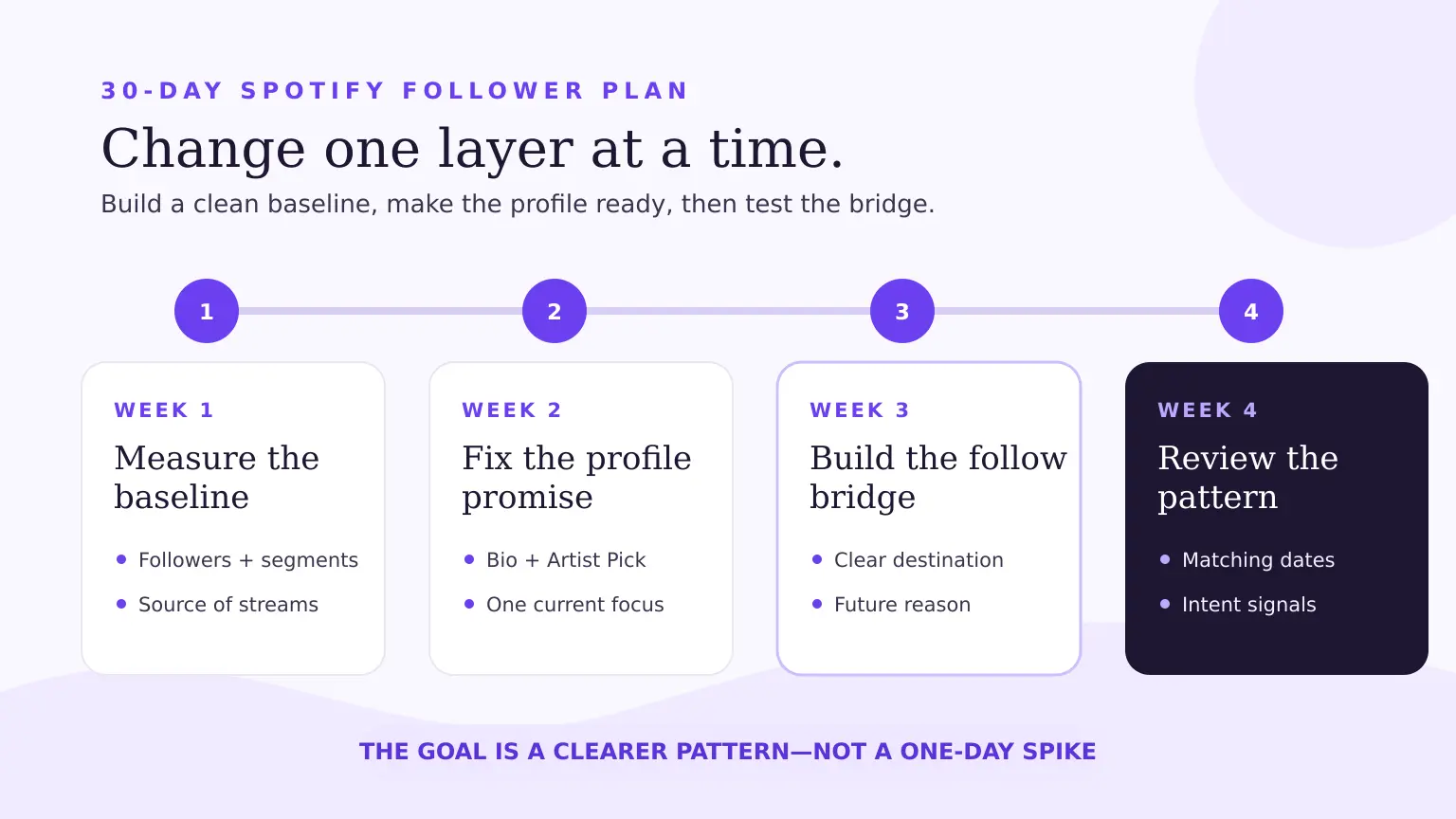
Week 1 — Measure the baseline. Review follower totals, audience segments and source of streams. Choose one release or profile destination to support.
Week 2 — Fix the profile promise. Update the artist image, bio, Artist Pick and relevant social links. Make sure the page matches the music currently earning attention.
Week 3 — Build the follow bridge. Publish several distinct pieces around one musical idea. Use a clear Spotify destination and a specific reason to follow.
Week 4 — Compare the pattern. Recheck the same date ranges and metrics. Keep the message or route that created stronger intentional behavior; change the part that did not.
Your end-of-month checklist
- I compared active and programmed sources.
- My profile reflects the music I’m promoting now.
- My Artist Pick has a clear, current purpose.
- Each promotional post leads to the right Spotify destination.
- My follow request offers a specific future reason.
- I recorded campaign and release context beside the numbers.
- I reviewed followers together with intentional listening signals.
Where FastSocialz can help
If the music and profile are ready but consistent promotion is the bottleneck, FastSocialz Spotify Growth can support the audience-building work around your release. It should complement a clear artist identity, strong music and honest measurement—not replace them. No password is required, and results are never guaranteed.
Final thoughts
More listeners can create an opportunity. They do not create a relationship by themselves.
The useful shift is from asking, “How do I turn all these listeners into followers?” to asking, “What would make the right listener choose to come back?” Once you can see where discovery happens, what the profile communicates and which message earns intentional action, follower growth becomes less mysterious—and your next campaign becomes easier to improve.
Structured support, no account access
Where a growth service fits on Spotify
Content and profile conversion come first, and no service changes that. A growth service cannot repair a vague bio, an audience that was never yours, or a post that gives viewers no reason to follow.
What it can do is handle the part most people never get around to: putting your profile in front of the right audience, consistently, while you concentrate on the content. FastSocialz builds campaigns by hand and runs them from your public profile link, so it never asks for your Spotify password and never logs in as you.
Explore Spotify Growth →No growth service can promise that a given number of views will produce a given number of listeners.Questions, answered plainly
Frequently asked questions
Are Spotify monthly listeners the same as followers?
No. Monthly listeners are unique people who streamed your music during the last 28 days. Followers are people who chose to follow your artist profile.
What is the best Spotify follower-to-listener ratio?
Spotify does not publish one universal target for every artist. Playlist exposure, genre, release timing, catalog size, and the mix of active versus programmed listening can all change the relationship. Track your own baseline across comparable periods.
Do Spotify followers receive every new release?
Spotify says followers can discover new music through surfaces such as Release Radar and What's New. Release Radar is personalized, so every follower should not be promised the same visibility or behavior.
Should I send people to my song or artist profile?
Match the destination to the message. A post about one track should usually lead to that track. A broader introduction, story, or catalog message can lead to the artist profile.
How long should I test this plan?
Thirty days gives enough room to prepare the profile, repeat the follow message in different ways, and compare similar reporting windows. It is a starting cycle, not a guaranteed outcome.
Keep reading
Related guides
How to Add Chapters to YouTube Videos
A practical guide to planning, formatting, publishing, and checking YouTube chapters without turning your description into a mess.
YouTube Impressions Up but CTR Down? 7 Checks Before You Change Your Thumbnail
A falling click-through rate is not automatically bad when YouTube is showing your video to more people. Use these seven checks before changing the thumbnail.
YouTube Dynamic Thumbnails vs A/B Testing: What Creators Should Know
YouTube has announced dynamic thumbnails and video-cut testing, but its existing A/B tool works differently. Here is what each option tests and what creators can do now.