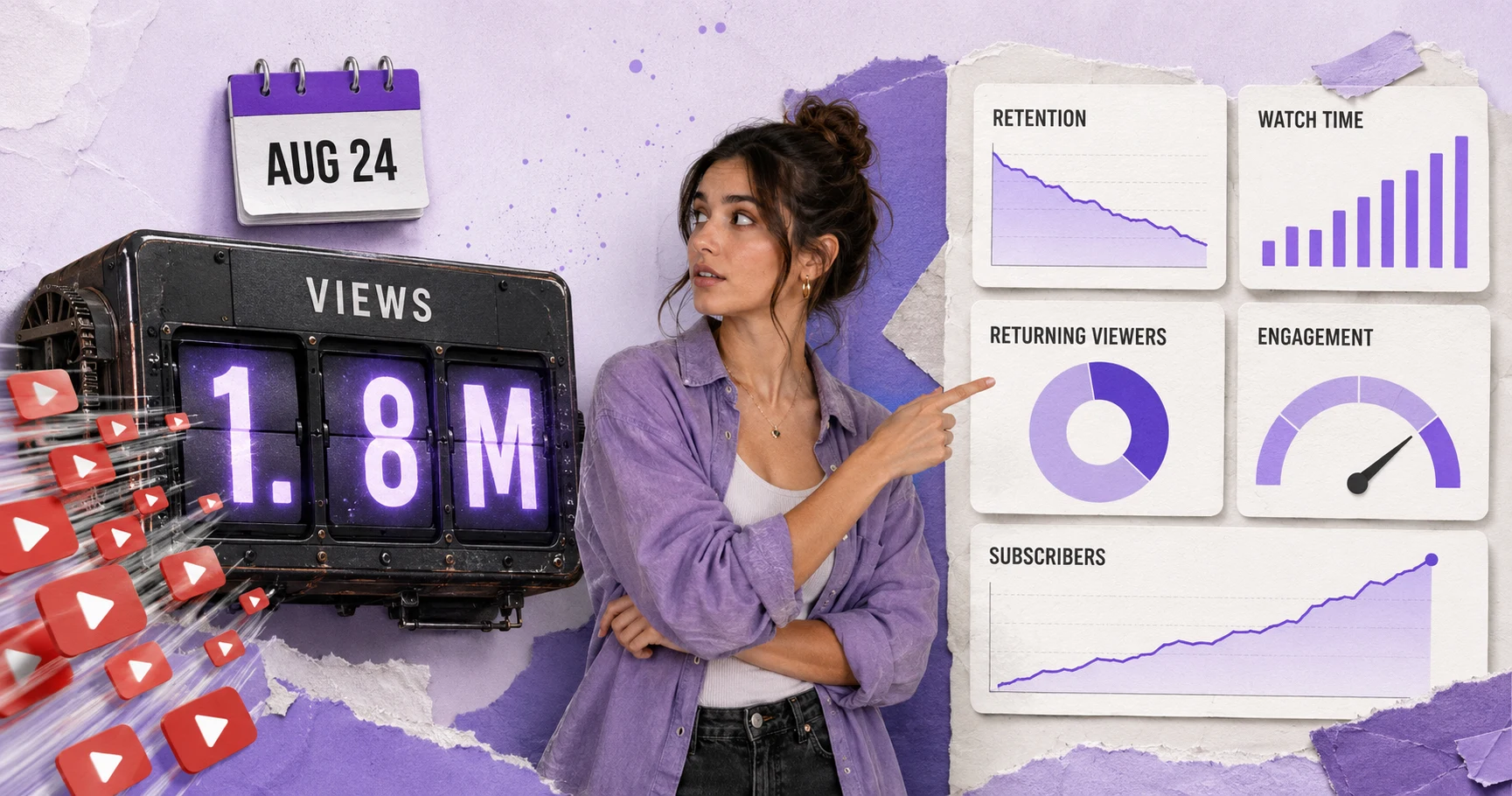
Your YouTube numbers may look better on Monday even if nobody suddenly became more interested in your videos.
Beginning August 24, 2026, YouTube will count public views the moment a video starts to play. The same rule will apply to Shorts, long-form videos and live streams. That makes the public views count a cleaner measure of playback starts—but a weaker shortcut for judging whether people actually stayed.
This isn’t free channel growth. It’s a measurement change.
The creators who read it correctly will separate exposure from attention, subscriber conversion and repeat viewing. Everyone else risks celebrating a larger number without checking what happened underneath it.
Five takeaways before the rule changes
- Public views will measure starts. They won’t tell you how deeply somebody watched.
- All major video formats use the same public counting point. Shorts, videos and live streams will count views when playback begins.
- YPP rules don’t move with the public counter. YouTube says earnings still use engaged Shorts views and engaged watch hours; eligibility still uses qualified Shorts views and qualified watch hours.
- Your historical comparison needs a marker. August 24 creates a reporting break, so don’t read a post-change increase as pure audience growth.
- Subscriber and returning-viewer signals become more useful. They show whether a playback start developed into a relationship with the channel.
What exactly changes on August 24?
YouTube’s official announcement says public views will count from the moment a video begins playing, with no minimum watch time. The rule covers video on demand, Shorts and live streams.
Until now, public views counting wasn’t consistent across those formats. A creator could look at two view totals and assume they represented the same level of attention when the underlying rules differed. YouTube is standardizing the point at which public views begin.
Here’s the practical version:
| Area | From August 24, 2026 | What it tells you |
|---|---|---|
| Public views | Count when playback begins | How often content started playing |
| Formats covered | Shorts, long-form and live | A more consistent public counting method |
| YPP earnings | No announced change | Earnings still depend on engaged metrics |
| YPP eligibility | No announced change | Qualified views and watch hours still matter |
| YouTube Analytics | Engagement metrics remain available | Whether viewers stayed after the start |
The update makes public views easier to compare across formats at the starting line. It doesn’t make those formats behave the same after that first frame. A three-second Short, a 20-minute tutorial and a two-hour live stream still demand different measures of success.

Why views alone will tell you less
Before the update, creators already knew that a view wasn’t the same as a loyal viewer. After August 24, that distinction becomes harder to ignore.
A playback can start because someone deliberately clicked a thumbnail. It can also start while a person samples a video and leaves quickly. Both can add to the public count under the new rule. Only the rest of the analytics tells you which experience occurred.
Imagine two hypothetical videos.
The first starts 50,000 times, but most viewers leave almost immediately and very few subscribe. The second starts 8,000 times, holds attention through the key section and brings back viewers for the next upload. The first has the larger public number. The second may be building the healthier channel.
That doesn’t make public views useless. They still reveal exposure. The mistake is asking one metric to answer four different questions:
- Did the video start?
- Did the viewer stay?
- Did the content earn a subscription?
- Did the person return later?
Public views now answer the first question. Your channel strategy depends on the other three as well.
The six YouTube metrics worth watching now
YouTube’s Content analytics documentation provides the pieces needed to build a better reading of performance.
| Metric | The question it answers | Best use |
|---|---|---|
| Public views | How often did playback begin? | Exposure and format-level reach |
| Unique reach | Roughly how many individual people saw the content? | Separating people reached from repeated plays |
| Engaged views or “stayed to watch” | Did viewers continue beyond the opening moments? | Shorts attention quality |
| Watch time, average view duration and retention | How much attention did the content hold? | Long-form and live depth |
| Subscribers gained | Which content converted viewers into subscribers? | Channel-promise and topic fit |
| New, casual and regular viewers | Are people developing a viewing habit? | Audience loyalty over time |
No universal ratio works for every niche, format or channel size. A tutorial, music video, product review and comedy Short create different viewing behavior. Compare a video with your own similar content, not with a benchmark pulled from another creator’s screenshot.
Public views: exposure, not depth
Use this number to understand how often a video started. It is still valuable for seeing which topics, formats or distribution sources create the most opportunities for attention.
After August 24, don’t describe public views as proof that somebody meaningfully watched. It records the start.
Engaged views and “stayed to watch”: the Shorts reality check
For Shorts, YouTube defines engaged views as the number of times viewers stayed beyond the initial seconds, excluding loops. The “stayed to watch” percentage shows how often people chose to continue rather than swipe away.
If public views rise while engaged views barely move, the opening reached more screens without holding proportionally more people. That is a creative signal, not necessarily an algorithm problem.
Watch time and retention: the long-form truth
For long videos, watch time, average view duration and the audience-retention curve show what happens after the click.
Look for the moment where viewers leave. If the sharpest drop comes during a long introduction, the title and thumbnail may have earned the click while the opening delayed the promised value. If viewers hold through the main explanation but leave during the outro, the core content may be doing its job.
Retention is useful because it turns “people didn’t watch” into a location you can inspect.
Subscribers gained: did the video create a reason to return?
YouTube shows subscriber gains by content type, including videos, Shorts, live streams and posts. This matters more after the counting change because it separates a playback start from a conscious decision to hear from the channel again.
A video usually earns subscribers when it makes a clear promise about what comes next. A random viral clip can attract attention without explaining why the channel deserves a place in the viewer’s future.
New, casual and regular viewers: is an audience forming?
YouTube classifies viewers based on how consistently they return. New viewers are seeing the channel for the first time. Casual viewers have watched occasionally over a period of months. Regular viewers have watched consistently for a longer period.
Those groups prevent a common mistake: treating every new view as permanent audience growth. Reach can arrive in a day. A viewing habit takes repeated, recognizably useful content.
Read the change differently for Shorts, long-form and live
The public counting rule becomes consistent. Your diagnosis shouldn’t.
For Shorts
Start with public views, then immediately check:
- engaged views;
- stayed to watch;
- average percentage viewed;
- subscribers gained;
- traffic from the Shorts feed versus other sources.
A Short that starts often but loses viewers in the first moments needs a stronger opening or a clearer idea. A Short that holds attention but earns few subscribers may feel complete as a one-off—it gives no reason to expect another useful video from the channel. If you want more of those starts to come from a relevant audience in the first place, our YouTube growth service focuses on targeted exposure rather than raw view totals.
For long-form videos
Read performance as a sequence:
- Impressions: Did YouTube show the thumbnail?
- Click-through rate: Did the packaging earn a click?
- Public views: Did playback start?
- Average view duration and retention: Did the video deliver?
- Subscribers and returning viewers: Did the channel earn another visit?
This sequence helps locate the weak point. Changing a thumbnail won’t fix an introduction that loses viewers. Re-editing the first minute won’t fix a topic nobody wanted enough to click.
For live streams
The new public count records entries into the stream. Pair it with:
- peak and average concurrent viewers;
- average view duration;
- total watch time;
- subscribers gained during or around the stream;
- traffic sources.
A live stream can collect many brief entries while maintaining a much smaller active audience. That isn’t necessarily failure—people sample live content—but public views and concurrent viewers describe different realities.
Build a clean before-and-after baseline
The most useful action you can take before August 24 is boring: save a snapshot.
Open YouTube Studio, move to Analytics, and export or record the last seven days by format. Keep Shorts, long-form and live separate. Capture:
- public views;
- engaged views or stayed-to-watch data where available;
- watch time;
- average view duration or average percentage viewed;
- subscribers gained;
- unique reach;
- new, casual and regular viewers;
- primary traffic sources.
After seven full days under the new rule, run the same report again. Don’t ask only whether views increased. Ask:
- Did engaged attention rise with playback starts?
- Did watch time grow at a similar pace?
- Which format gained subscribers most efficiently?
- Did unique reach increase, or did repeat playback account for more of the movement?
- Did new viewers begin returning?
The goal isn’t to manufacture a perfect ratio. It is to prevent a reporting change from disguising a creative or audience problem. If distribution turns out to be the weak link rather than the content itself, how our campaigns work and the current plans and pricing explain what managed promotion can and cannot do.
Four mistakes creators are likely to make
1. Calling the first increase “growth”
If views rise immediately after the rule changes, part of the movement may come from the new counting method. Growth requires another signal: more unique people, more attention, more subscribers or more returning viewers.
2. Comparing August and July without a note
A chart can be mathematically correct and still tell the wrong story. Mark the methodology change in internal reports, sponsor decks and client updates.
3. Optimizing only for the first frame
The first frame now earns the public views count, but the rest of the video earns watch time, subscribers and another visit. A strong opening with a weak payoff creates impressive starts and disappointing depth.
4. Treating every format as one funnel
Shorts are sampled rapidly, long-form videos ask for a larger time commitment and live streams collect drop-ins. Use the same public-views definition, but judge the content with format-appropriate engagement metrics.
A seven-day action plan
Use this sequence rather than changing your entire content strategy because one number moves.
Before August 24
- Save the seven-day baseline.
- Label the date of the measurement change.
- Identify your current top subscriber-converting content by format.
August 24–26
- Watch for reporting or dashboard changes.
- Avoid announcing a dramatic “growth spike” based only on public views.
- Confirm that engaged and qualified metrics remain visible in the relevant Analytics reports.
August 27–30
- Compare view starts with engaged attention and watch time.
- Review the opening moments of videos with the widest gap.
- Check which content earned subscribers, not merely starts.
On August 31
- Compare the first complete post-change week with the saved baseline.
- Keep Shorts, long-form and live in separate sections.
- Write one decision for each format: packaging, opening, depth, channel promise or distribution.
One decision per format is enough. Changing thumbnails, topics, upload frequency and editing style at the same time makes the next report harder to interpret.
Sources
This article was researched on August 22, 2026, for publication on August 23.
- YouTube’s official public-views-count announcement
- YouTube Help: Understand your content performance
- FastSocialz terms of service
Final takeaway
After August 24, the public views counter tells you that a video started. It doesn’t tell you whether the viewer stayed, subscribed or came back.
That isn’t a reason to ignore views. It is a reason to give them a smaller job.
Use public views to read exposure. Use engaged attention and watch time to judge the content. Use subscribers and regular viewers to judge whether the channel is becoming something people choose twice.
Structured support, no account access
Where a growth service fits on YouTube
Content and profile conversion come first, and no service changes that. A growth service cannot repair a vague bio, an audience that was never yours, or a post that gives viewers no reason to follow.
What it can do is handle the part most people never get around to: putting your profile in front of the right audience, consistently, while you concentrate on the content. FastSocialz builds campaigns by hand and runs them from your public profile link, so it never asks for your YouTube password and never logs in as you.
Explore YouTube Growth →No growth service can promise that a given number of views will produce a given number of subscribers.Questions, answered plainly
Frequently asked questions
When does YouTube’s new views-count rule start?
YouTube says the rule begins on August 24, 2026. Public views will count when playback starts across Shorts, long-form videos and live streams.
What counts as a YouTube view after August 24, 2026?
Public views count from the moment a video begins playing, with no minimum watch-time requirement for that public counter.
Will every creator’s YouTube views increase?
The rule can make public views accumulate faster, but YouTube does not guarantee a specific increase. The effect will vary with playback starts and the creator’s mix of Shorts, long-form and live content.
Does the views-count change affect YouTube monetization or eligibility?
No. YouTube says earnings still depend on engaged Shorts views and engaged watch hours, and Partner Program eligibility still uses qualified Shorts views and qualified watch hours rather than the new public views count.
What is the difference between public views and engaged views?
From August 24, public views record playback starts. For Shorts, engaged views count occasions when viewers stayed beyond the initial seconds, excluding loops. Engagement and watch-time metrics show attention after the start.
Should I compare the new view counts with older YouTube reports?
You can, but mark August 24 as a methodology change and compare attention, subscriber and audience metrics alongside public views. A raw before-and-after view comparison may overstate the change in viewer behavior.
Keep reading
Related guides

How to Add Chapters to YouTube Videos
A practical guide to planning, formatting, publishing, and checking YouTube chapters without turning your description into a mess.
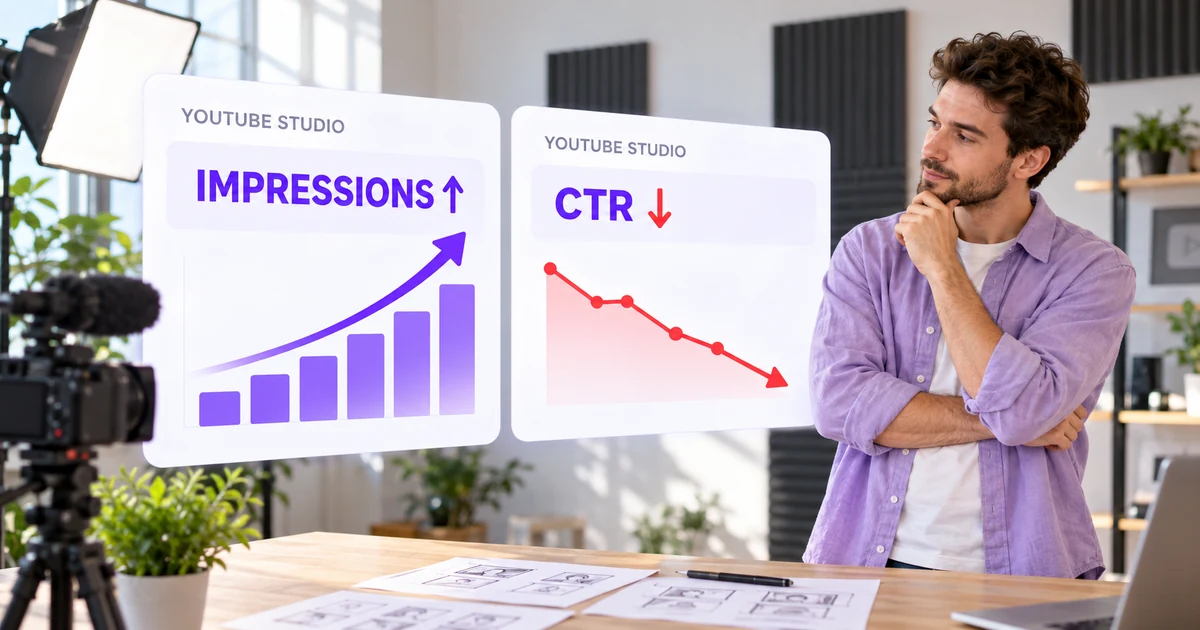
YouTube Impressions Up but CTR Down? 7 Checks Before You Change Your Thumbnail
A falling click-through rate is not automatically bad when YouTube is showing your video to more people. Use these seven checks before changing the thumbnail.
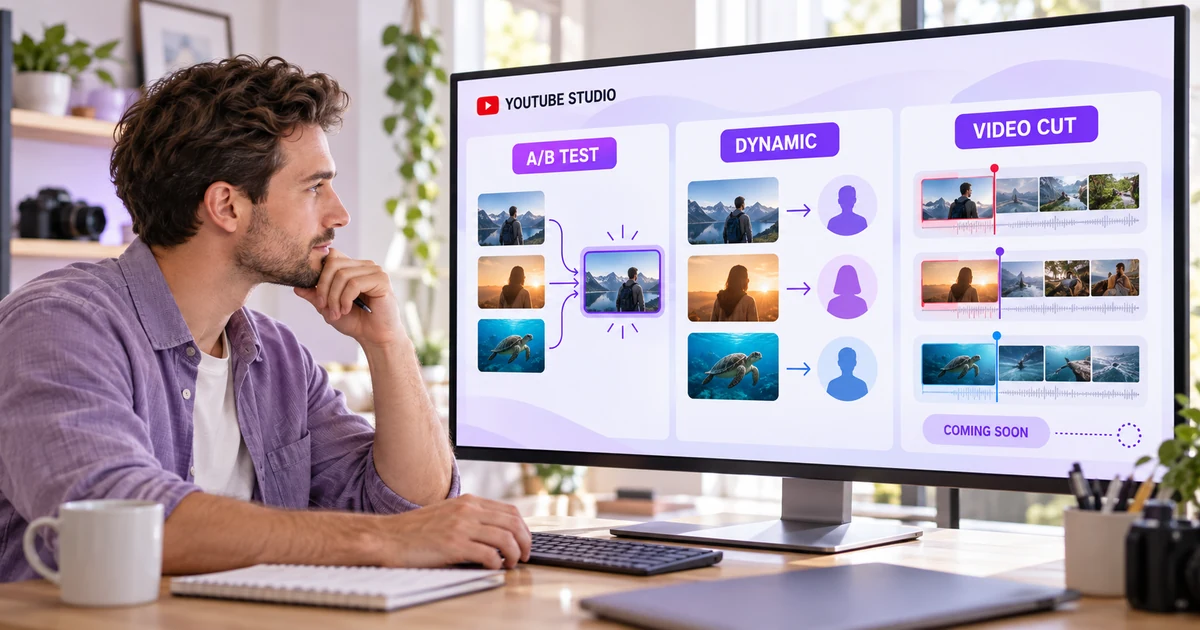
YouTube Dynamic Thumbnails vs A/B Testing: What Creators Should Know
YouTube has announced dynamic thumbnails and video-cut testing, but its existing A/B tool works differently. Here is what each option tests and what creators can do now.