This comparison uses YouTube’s current Help Center definitions, analytics reports, format rules, and Partner Program guidance. It doesn’t rank one format as universally better. The useful question is which format fits the job your next video needs to do.
Quick verdict
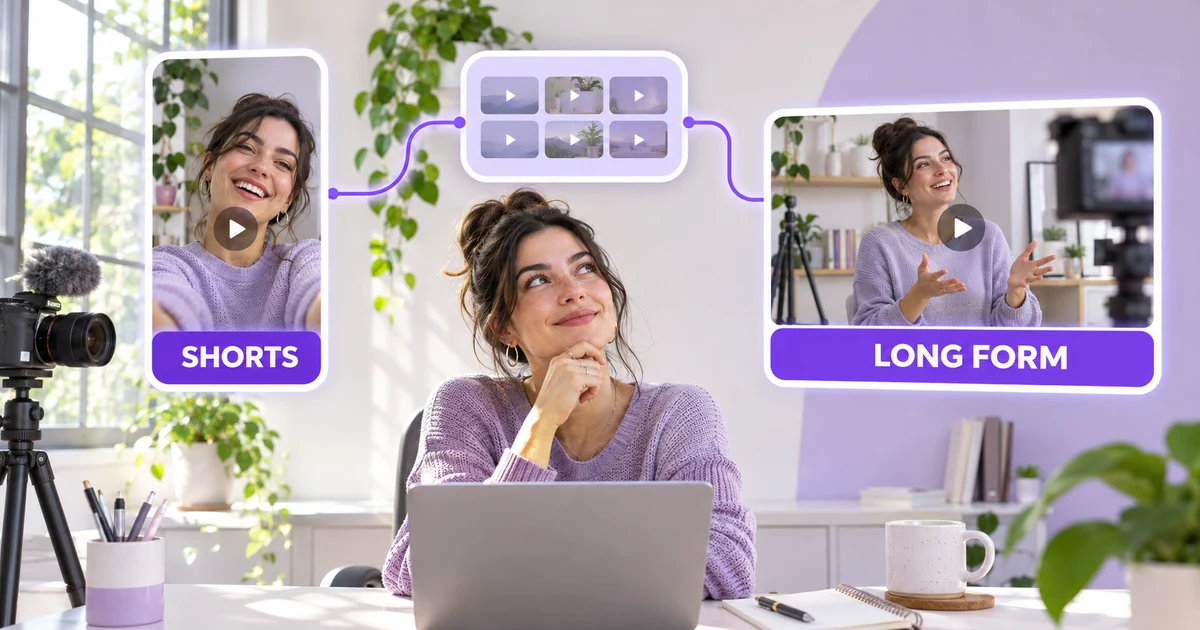
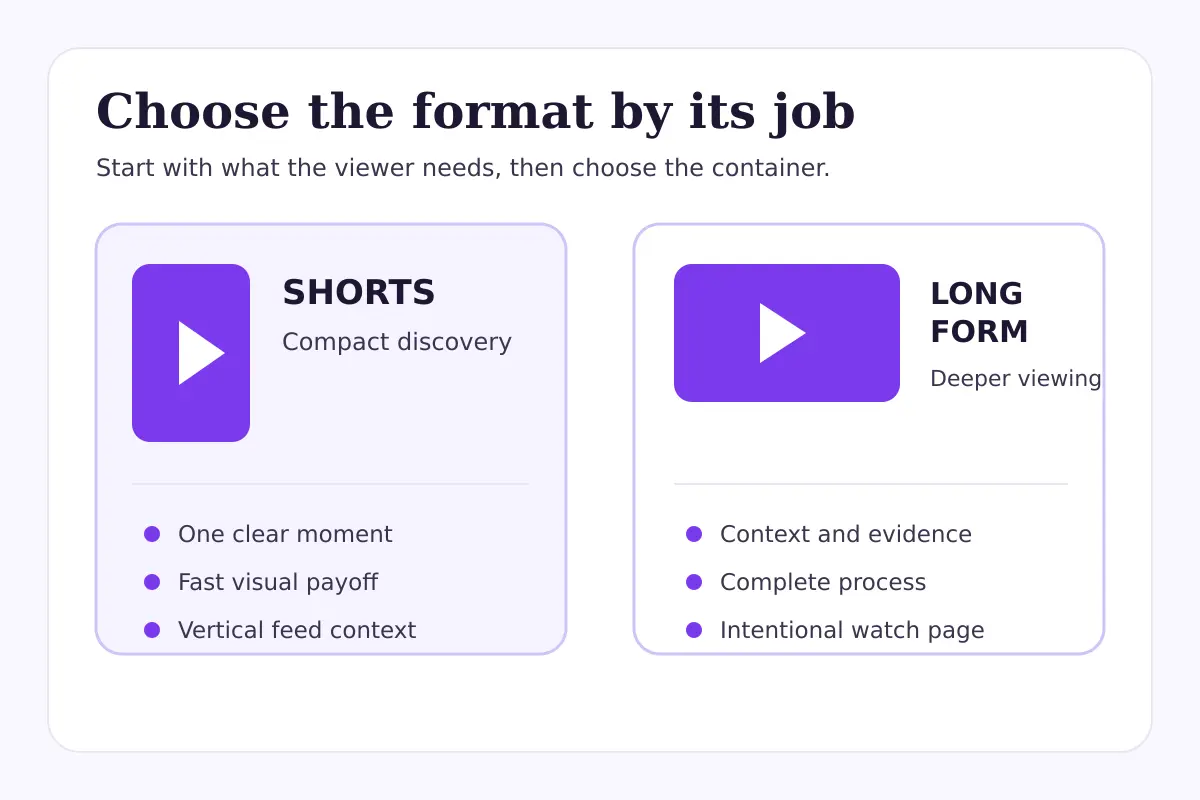
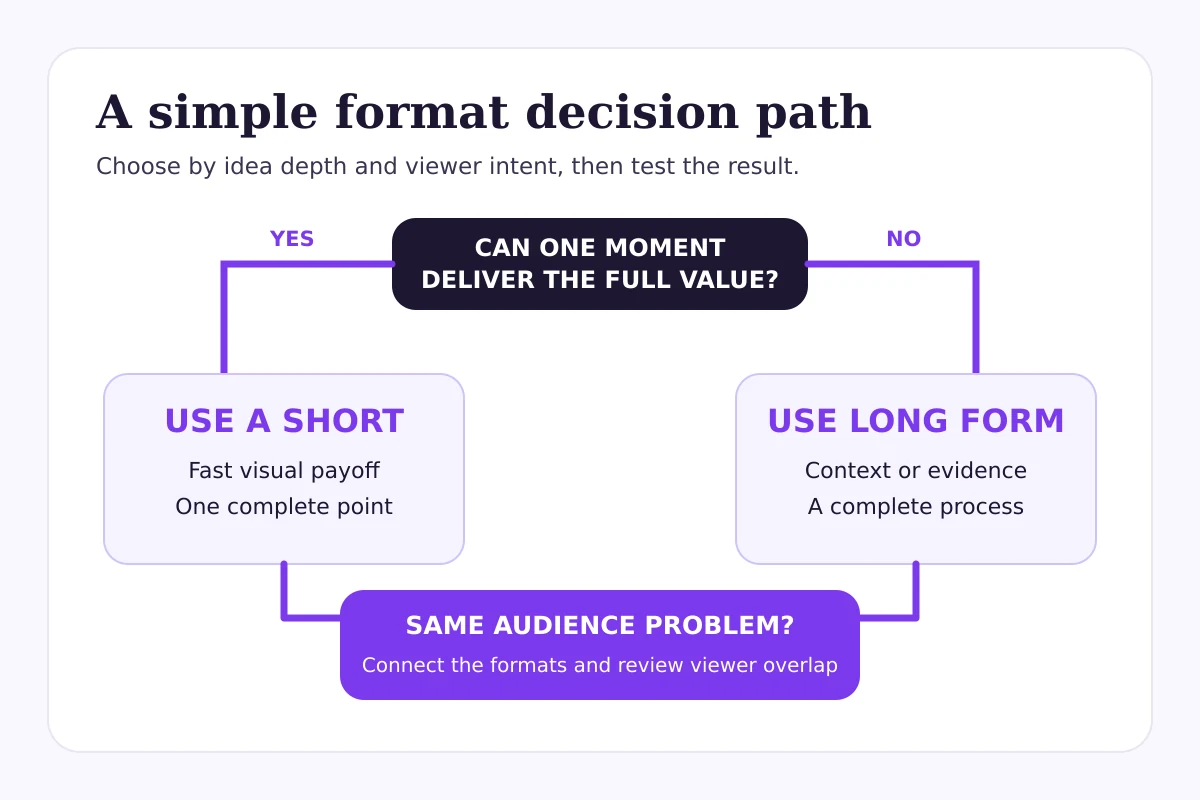
Choose Shorts when the idea works as a compact, visually immediate moment and your priority is discovery inside a swipe-based feed. Choose long-form video when the viewer needs explanation, proof, a complete story, or enough time to make a decision.
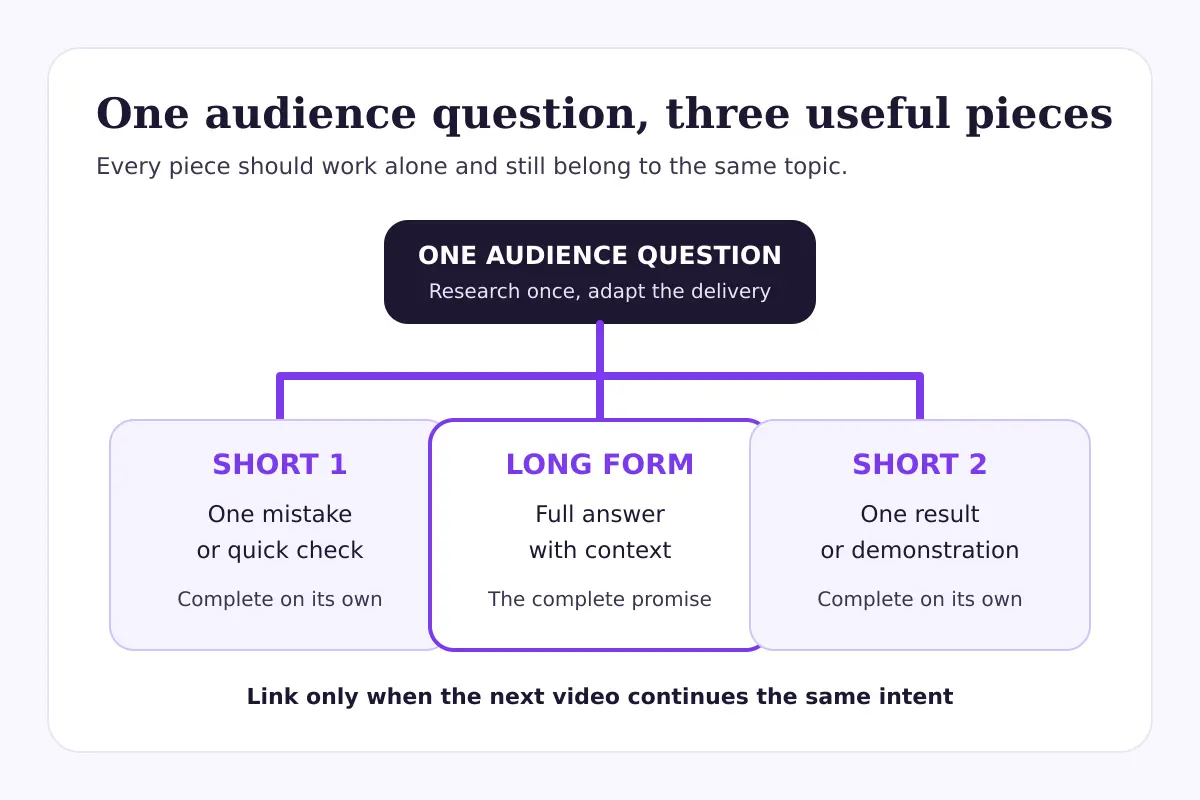
For many channels, the strongest answer is a deliberate mix: a long-form video handles the complete promise, while one or two related Shorts introduce a specific moment from that topic. The formats should share an audience problem, not merely a keyword.
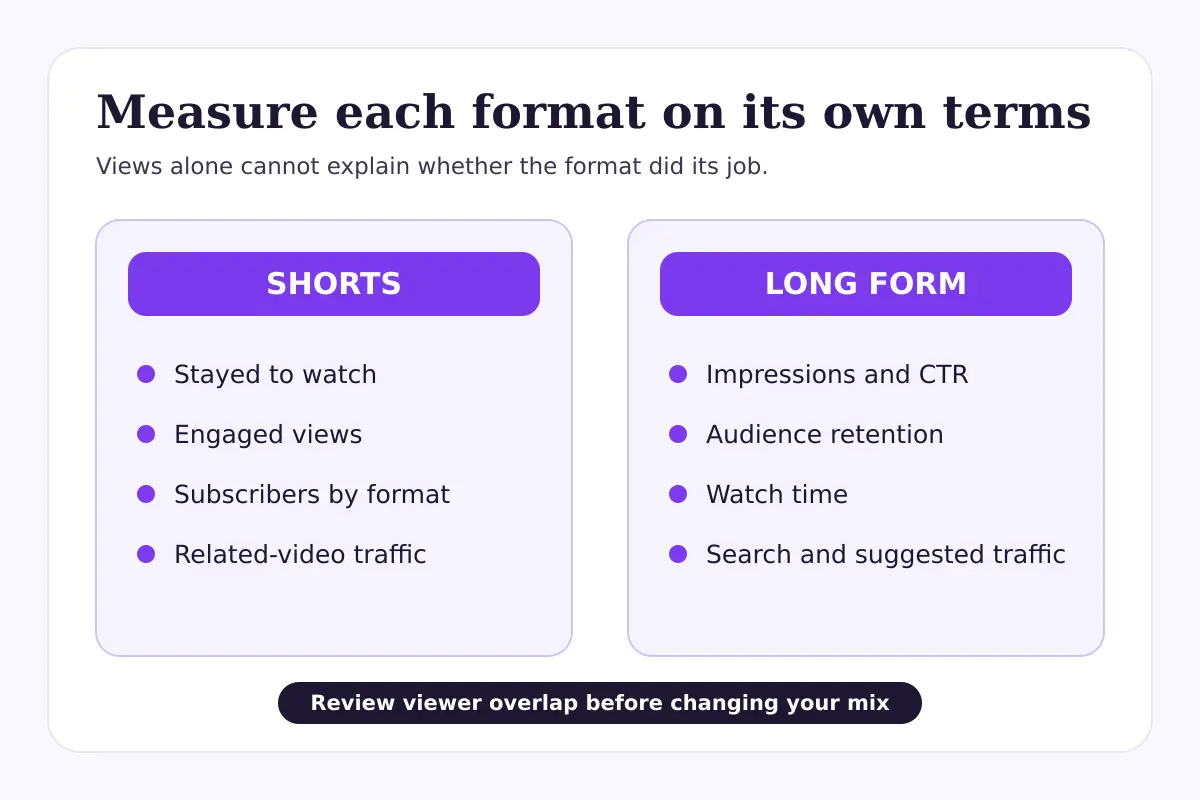
YouTube provides separate Video and Shorts views inside the Content tab, plus a “Viewers across formats” report. That makes it possible to test the mix with your own audience instead of adopting a generic upload ratio.
The criteria that matter
A useful format decision starts with five questions:
- What must the viewer understand or feel? A single reveal may fit a Short. A process with context, trade-offs, and evidence usually needs more room.
- How will the viewer encounter it? Shorts are designed for vertical feed discovery. Long-form videos can be found through search, browse, suggested videos, channel pages, and external links.
- What action should follow the view? Watching another clip is a smaller step than comparing options, following a tutorial, or considering a service.
- Can the idea stand alone? A Short that feels like an incomplete advertisement is easy to swipe away from. A strong Short delivers value even when nobody continues to another video.
- What can your team produce consistently? A sustainable format is more useful than an ambitious schedule that collapses after two weeks.
Shorts vs long-form at a glance
| Decision factor | YouTube Shorts | Long-form videos |
|---|---|---|
| Typical viewing context | Fast, vertical discovery feed | Intentional viewing across watch pages, search, browse and suggested content |
| Current format boundary | Square or vertical videos up to three minutes can be categorized as Shorts when they meet YouTube’s current rules | Videos outside the Shorts classification, commonly presented on the standard watch page |
| Best fit | One idea, moment, demonstration, reaction, result or concise story | Tutorials, reviews, interviews, analysis, case explanations and longer narratives |
| Packaging emphasis | The opening moment and immediate clarity | Title, thumbnail, opening promise and sustained delivery |
| Useful analytics | Stayed to watch, engaged views, subscribers, traffic and audience behavior | Impressions, CTR, watch time, audience retention, subscribers and traffic sources |
| Partner Program path | Qualified public Shorts views | Qualified public watch hours from long-form videos |
| Main production risk | Compressing too much or posting clips without a complete point | Slow introductions, unnecessary length or a weak title-thumbnail promise |
| Bridge to other content | Add a related video that matches the Short’s intent | Use chapters, cards, end screens and related series planning |
The table describes how the formats are used, not a promise about results. A well-matched long-form video can reach a large new audience, and a Short can build a meaningful returning audience. Execution, topic demand, viewer satisfaction, and channel history all matter.
Where Shorts are the better fit
Shorts work well when the idea becomes clearer through speed rather than explanation. A quick before-and-after, a single mistake, a compact demonstration, a reaction, or one surprising detail can be complete in a short vertical sequence.
The feed also changes the packaging problem. A viewer does not always choose a Short from a row of thumbnails; the content can begin playing as part of a swipe session. That makes the opening image, movement, statement, or question especially important. The first seconds must establish what the viewer is about to get.
YouTube currently allows Shorts up to three minutes when the video meets its square-or-vertical classification rules. That extra room can support a mini-story, but it does not mean every Short should stretch to the limit. The right length is the shortest version that delivers the promised idea without feeling cut off.
Shorts are especially useful for:
- testing several angles around one broader topic;
- showing one result or technique from a longer process;
- answering a narrow question with a visual demonstration;
- giving an existing long-form topic another discovery entry point;
- publishing timely observations that do not justify a full production.
The limit is depth. If the viewer needs definitions, comparison criteria, caveats, setup steps, or proof, aggressive compression can make the content feel shallow. In that case, the problem is not the creator’s editing speed. The idea simply needs a longer container.
Where long-form video is the better fit
Long-form earns its place when the viewer’s question cannot be resolved in one moment. A product comparison needs criteria. A tutorial needs setup, sequence, and troubleshooting. An interview needs context. A documentary needs a narrative that has time to develop.
The standard watch page also gives the creator more packaging and navigation tools. A carefully matched title and thumbnail help a viewer decide to begin. Chapters can make a substantial video easier to navigate. Cards and end screens can connect related material. Those tools are useful when the channel is building a library rather than a stream of isolated moments.
Long-form is usually the stronger fit for:
- tutorials with multiple dependent steps;
- reviews where evidence and trade-offs matter;
- educational topics that require definitions and examples;
- stories built around tension, change, or a complete journey;
- topics likely to be searched or referenced again;
- content meant to support a considered business or purchase decision.
Length itself is not the advantage. A twelve-minute video with four minutes of useful material is still inefficient. The advantage is permission to use the time the idea genuinely requires.
Measure each format on its own terms
Comparing raw Shorts views with raw long-form views can hide more than it reveals. Since August 24, 2026, YouTube counts a view when playback starts across Shorts, long-form videos, and live streams. YouTube still uses separate qualified and engaged measures for Partner Program eligibility and earnings.
Use the Content tab in YouTube Analytics to review Videos and Shorts separately. Then use the All view and “Viewers across formats” report to understand whether the same people are consuming both.
For Shorts, examine:
- stayed to watch versus swiped away;
- engaged views and watch behavior;
- subscribers gained from the format;
- traffic sources and repeat viewing patterns;
- whether a related-video link attracts relevant next views.
For long-form, examine:
- impressions and click-through rate in context;
- audience retention and watch time;
- traffic sources such as search, browse, and suggested videos;
- new, casual, regular, and returning viewers;
- subscribers and next-video behavior.
Do not collapse those signals into one invented score. A Short may be valuable because it reaches new viewers, while a long-form video may be valuable because it answers a high-intent question. The goals differ, so the success criteria should differ too.
A mixed-format strategy that stays coherent
The common mistake is to turn every long video into several random clips. A clip can be technically related and still attract a different audience. The better bridge preserves the viewer’s intent.
Suppose a channel publishes a long-form video called “How to Plan a Small Balcony Garden.” Useful related Shorts might show a 30-second drainage check, three plants that tolerate afternoon sun, or one mistake that damages roots. Each Short solves a small problem on its own, while the long video delivers the complete system.
YouTube lets creators add a related video to a Short. Use that feature when the destination directly continues the same question. A viewer who watched a fast plant-care tip should land on the relevant section or receive the promised answer quickly, rather than sit through an unrelated channel introduction.
A simple production loop looks like this:
- Choose one audience problem with enough depth for a complete long-form video.
- Identify two or three moments that are independently useful in vertical form.
- Produce the long-form video and Shorts from the same research, while rewriting each opening for its viewing context.
- Add the most relevant long-form video as the related video on each Short.
- Review cross-format audience overlap and next-view behavior before repeating the pattern.
A hypothetical channel decision
Consider a hypothetical bookkeeping channel with enough capacity for one detailed production and two simple clips each week. Its goal is to attract small-business owners who need practical help.
The creator could publish a long-form walkthrough on reconciling a month of transactions, then create one Short showing a fast duplicate-charge check and another explaining a common receipt-labeling mistake. The Shorts introduce narrow problems that the intended audience recognizes. The long-form video handles the full workflow.
After four weeks, the creator should not ask only which format earned more views. A better review would ask:
- Did the Shorts reach viewers who also watch the channel’s long videos?
- Did either Short send relevant traffic through its related-video link?
- Did the long-form video continue attracting search or suggested traffic?
- Which topics gained subscribers who returned for another upload?
- Could the team sustain the production without weakening either format?
This scenario is illustrative, not a benchmark or expected result. A real channel should use its own Studio data.
Common decision mistakes
Treating Shorts as trailers
A trailer with no self-contained value asks a swipe-feed viewer to do extra work. Give the Short a complete point first. The longer video can extend that point.
Stretching every topic into long-form
Some ideas are one useful moment. Extra length adds repetition, not authority. If the viewer can receive the full answer in 40 seconds, publish the concise answer.
Comparing view totals without context
The discovery surfaces and viewer behaviors differ. Compare audience quality, next actions, and goal-specific metrics alongside views.
Changing the channel topic to chase a format
A Shorts trend can attract people who have little interest in the channel’s main promise. Format experiments should stay close enough to the same audience problem that a second view feels natural.
Publishing more than the team can learn from
Volume is not useful when nobody reviews the results. A smaller test with a clear hypothesis produces a better next decision.
A practical 30-day action sequence
Week 1: audit the audience and library. In YouTube Studio, check which formats your viewers watch, how viewers find your existing content, and whether the same viewers consume both formats. List three audience questions that are already supported by comments, search terms, or repeat topics.
Week 2: publish one complete long-form answer. Build it around the question that needs the most context. Make the title, thumbnail, and opening promise consistent. Add chapters if the video benefits from navigation.
Week 3: publish two standalone Shorts. Use moments that solve smaller parts of the same problem. Rewrite the hook for vertical viewing and add the relevant long-form video as a related video.
Week 4: review behavior, not just totals. Compare the formats separately, inspect cross-format viewers, note subscribers gained by content type, and look for relevant next views. Keep the pattern only if the audience connection and production load make sense.
If you want support promoting a coherent YouTube presence while keeping control of your content strategy, explore FastSocialz YouTube Growth. The service does not require your YouTube password, and no reach, subscriber, ranking, or revenue outcome is assured.
Frequently asked questions
Do YouTube Shorts hurt long-form video performance?
YouTube says Shorts and long-form videos have separate recommendation systems designed around the viewing patterns of each format, and it has not found evidence that Shorts inherently damage long-form performance. Topic mismatch can still produce an audience that does not move between formats, so review your cross-format data rather than assuming automatic transfer.
How long can a YouTube Short be?
YouTube currently allows square or vertical Shorts up to three minutes when they meet the platform’s classification rules. The best duration depends on the idea; the maximum is a limit, not a target.
Do Shorts watch hours count toward the long-form Partner Program threshold?
No. Qualified watch hours from Shorts views in the Shorts Feed do not count toward the qualified public watch-hours threshold. YouTube provides a separate eligibility path based on qualified public Shorts views.
Should I put Shorts and long-form videos on the same channel?
They can work on the same channel when they serve the same audience and topic promise. Use the “Viewers across formats” report and subscriber data by content type to see whether the connection is real for your channel.
How many Shorts should I post for each long-form video?
YouTube does not publish a universal ratio. Start with a production level you can sustain, such as one complete long-form video and one or two closely related Shorts, then adjust based on viewer overlap, next-view behavior, and content quality.
Sources and methodology
This comparison was reviewed on November 5, 2026 using YouTube’s official guidance on content performance and cross-format audience reports, three-minute Shorts, and related videos for Shorts. The performance guide also explains the separate engaged and qualified measures used for Shorts and long-form viewing. Current search results were reviewed to understand common decision questions; unsupported competitor statistics and universal posting ratios were excluded.
Final recommendation
Use Shorts for ideas that become stronger through immediacy. Use long-form when the viewer’s question deserves context, evidence, or a complete process. Combine them when both pieces serve the same audience and each piece works independently.
The most useful choice is the one your analytics can test. Define the job first, publish at a sustainable pace, and review whether viewers move from one relevant idea to the next.
About the author
FastSocialz Editorial Team creates practical, source-checked guides for creators, businesses, and agencies working across major social platforms.