
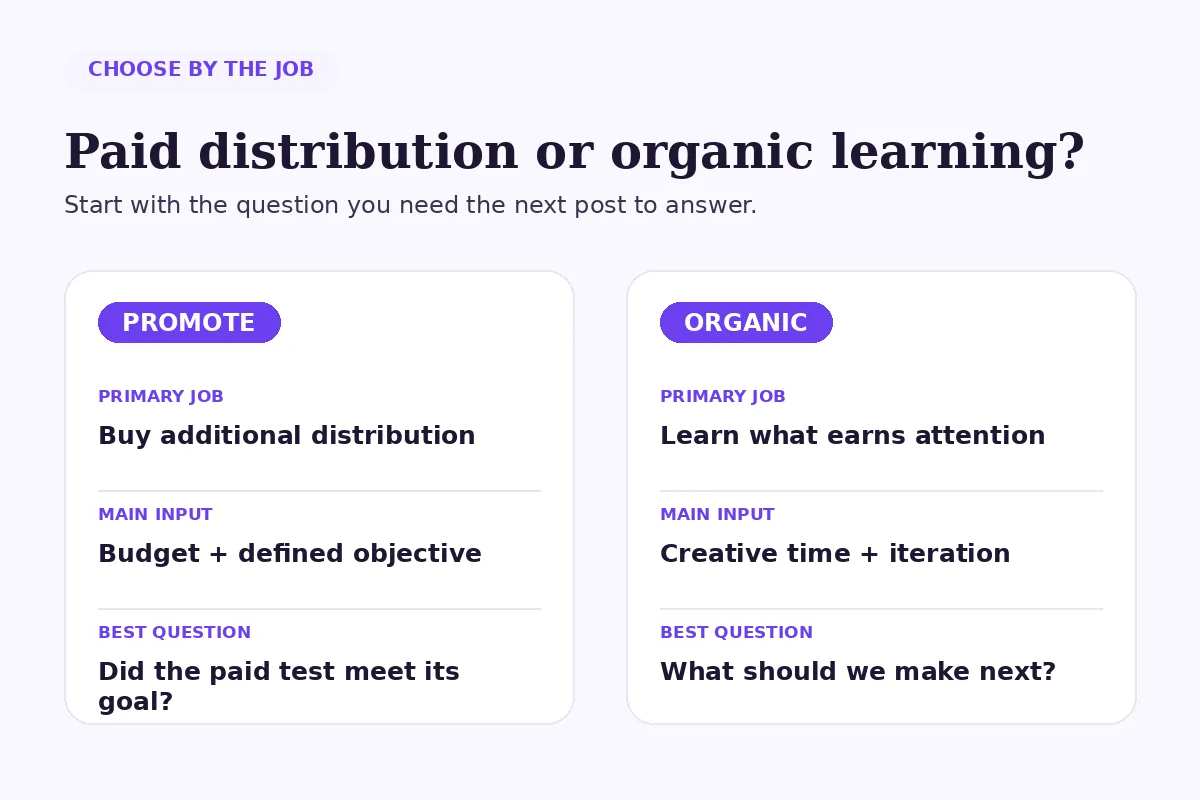
TikTok Promote and organic growth do different jobs. Promote pays to distribute an eligible public post toward a selected objective, while organic publishing tests whether the content earns attention through TikTok’s recommendation systems without paid placement.
If you’re still learning which topics, hooks and formats people respond to, start with organic content. If you already have a clear goal and a post that communicates it well, Promote can give that post additional paid distribution. Neither route guarantees followers, reach, engagement, sales or any other result.
The quick verdict
Choose organic first when your main question is, “What content should we keep making?” Choose Promote when the question is, “Should we pay to show this specific post to more people for a defined purpose?”
The strongest plan is often sequential rather than either-or: publish organically, learn from the response, then consider paid distribution for a post that already fits a real campaign goal. That doesn’t mean an organically popular post will automatically become an effective promotion. It simply gives you more evidence than choosing a video because someone on the team likes it.
This comparison is criteria-based. FastSocialz didn’t run a controlled paid-versus-organic experiment for this article, so there’s no invented winner, benchmark or return estimate.
TikTok Promote vs organic growth at a glance
| Question | TikTok Promote | Organic publishing |
|---|---|---|
| What are you controlling? | Budget, duration and the objective or audience options TikTok makes available | Topic, creative execution, publishing rhythm and community response |
| What are you buying? | Additional paid distribution for an eligible post | Nothing from TikTok; the cost is primarily creative time and operating effort |
| When does distribution stop? | Paid delivery normally ends when the promotion or budget ends | A post may continue being discovered, but continued distribution isn’t promised |
| What does it teach you? | How a promoted post performs against the selected paid objective | Which topics and creative choices earn attention without paid placement |
| Best starting use | A clear, time-bound objective attached to suitable content | Learning the audience, building a repeatable content system and testing ideas |
| Main limitation | More delivery can’t repair a confusing offer or weak next step | Distribution is variable and you can’t purchase certainty through consistency alone |
The word organic can be misleading here. It doesn’t mean effortless, free of strategy or guaranteed to compound. It only means the post isn’t receiving paid distribution through Promote or another advertising product.
What is TikTok Promote?
TikTok describes Promote as an advertising tool that can help improve the visibility and engagement of a post, typically by promoting it as an ad. It’s accessed from TikTok rather than requiring a full Ads Manager campaign build.
According to TikTok’s current Promote documentation, access and content eligibility conditions apply. Users must be at least 18, use an eligible account, and promote public content with original sound or audio cleared for commercial use. The exact objectives and audience controls shown can depend on the account and market.
That last point matters. Promote isn’t a button that certifies a video as good. It’s a simpler way to pay for distribution around the choices TikTok presents. You still need to decide what action would make the spend worthwhile.
What does organic TikTok growth actually mean?
Organic growth means publishing without paying TikTok to distribute the post. TikTok’s recommendation-system explanation says recommendations are shaped by signals including user interactions, content information and user information. The weighting can differ by surface and person.
For a creator or small team, organic publishing is therefore both communication and research. Each post can help you see whether the premise was clear, where viewers lost interest, what questions appeared and which idea deserves another version.
TikTok also advises creators to review analytics, engage with viewers and collaborate when working to grow an audience. None of those actions makes distribution predictable. They give you better information for the next decision.
If you need a more deliberate way to choose topics, start with our guide to TikTok Creator Search Insights and content gaps. Search demand is one useful input, not a promise that a finished video will perform.
Is TikTok Promote worth it?
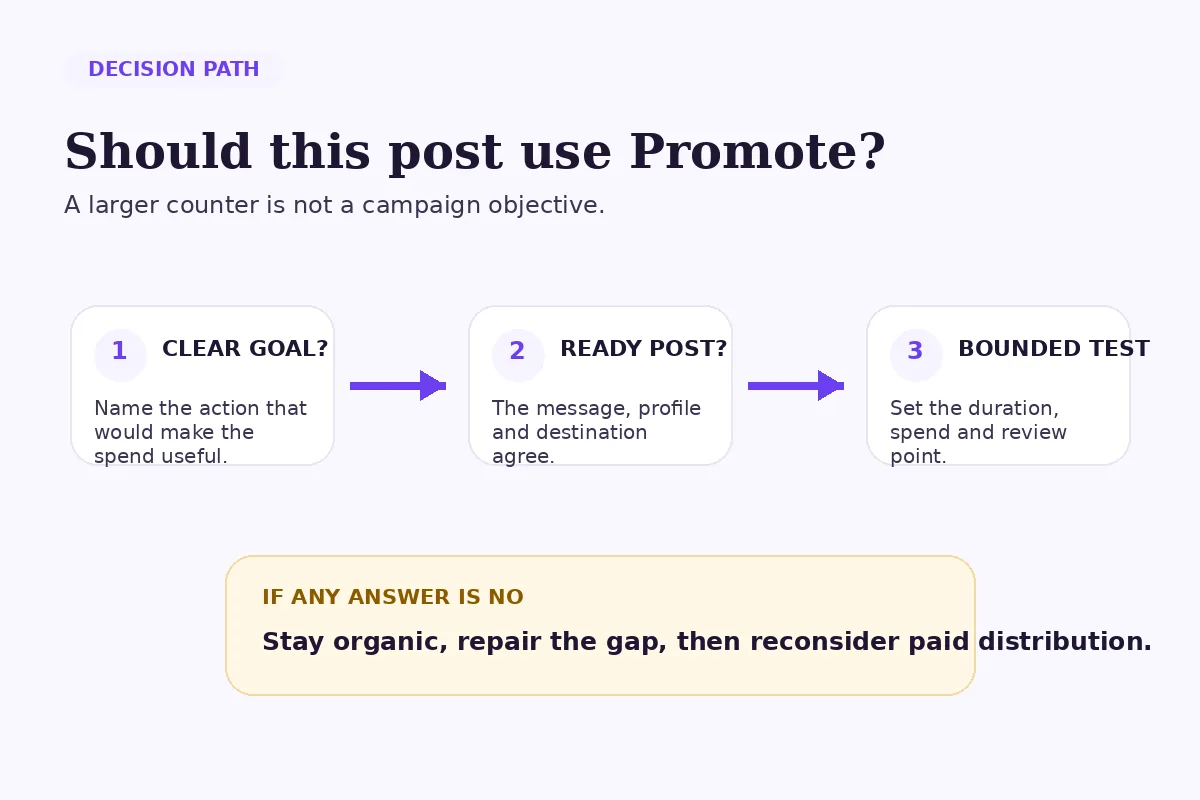
Promote can be worth testing when the post, audience and business objective already make sense together. It’s much harder to justify when the only goal is “get more views.” A larger view count tells you distribution happened; it doesn’t tell you whether the right people understood or acted on the message.
Before spending, complete this sentence: “This promotion is useful if people ___.” The blank might be visit a relevant page, discover an event, watch a complete explanation or another measurable action available for your selected setup. Then decide what you’ll review when the promotion ends.
Here’s a hypothetical example. Imagine a local pottery studio announcing a weekend workshop with a fixed booking deadline. A clear video, a relevant local audience and a trackable booking page create a coherent reason to test paid distribution. This scenario is illustrative, not a claim that Promote will fill the workshop or produce a particular cost per booking.
Promote is a weaker fit when the video is vague, the profile doesn’t explain the offer, or the landing page isn’t ready. Paid delivery can expose those gaps faster; it doesn’t remove them.
When should you rely on organic content instead?
Use organic content when you’re still discovering what the audience values or when your goal depends on an ongoing relationship rather than one campaign window. Tutorials, recurring series, replies and behind-the-scenes formats often need several attempts before their strongest version becomes obvious.
Organic is also the better diagnostic environment. If three posts cover the same idea with different openings, you can compare how the creative choices change viewer behavior without mixing paid distribution into every result. TikTok Studio provides post-level views, engagement information and trend charts that can support this review; TikTok outlines those tools in its TikTok Studio documentation.
Don’t turn “organic first” into “wait indefinitely.” Set a review point. After a sensible group of comparable posts, decide whether to continue the theme, change the presentation, or retire the idea. The lesson should come from the pattern, not from one unusually strong or weak post.
If you’re organizing several connected videos, a TikTok playlist can turn them into a clearer series when Creator Playlists are available on your account.
Does using Promote hurt future organic reach?
TikTok’s public Promote and recommendation documentation doesn’t state that paying to promote a post causes the account’s later organic posts to be suppressed. That means the common claim that TikTok deliberately reduces future reach to force more spending isn’t supported by the official materials cited here.
It would still be too strong to promise that Promote has no indirect effect on what you observe. Paid delivery changes who sees a post and can change the mix of views, profile visits and interactions around it. That makes a promoted post a poor baseline for judging your normal organic distribution.
Keep the records separate. Mark the dates when paid delivery started and ended, note the objective and budget, and compare organic posts with other organic posts. If you mix the two traffic sources into one line, the analysis becomes less useful.
Also separate poor distribution from a policy or eligibility issue. If TikTok shows a recommendation notice, follow the stated review process rather than trying to “fix” it with spend. Our explainer on TikTok posts that aren’t eligible for the For You feed covers that path.
Can Promote and organic publishing work together?
Yes, but only when each has a defined role. Organic content can identify promising messages and recurring audience questions. Promote can then test paid distribution for a chosen business objective. Afterward, organic publishing continues the conversation instead of assuming the paid campaign created a durable audience.
Suppose a consultant publishes a short series answering common onboarding questions. In this hypothetical example, one video produces several relevant profile visits and detailed questions, so the consultant considers promoting it to a suitable audience. The sensible measure would be the chosen next action—not simply whether the promoted view counter became larger. This is not a benchmark or promised result.
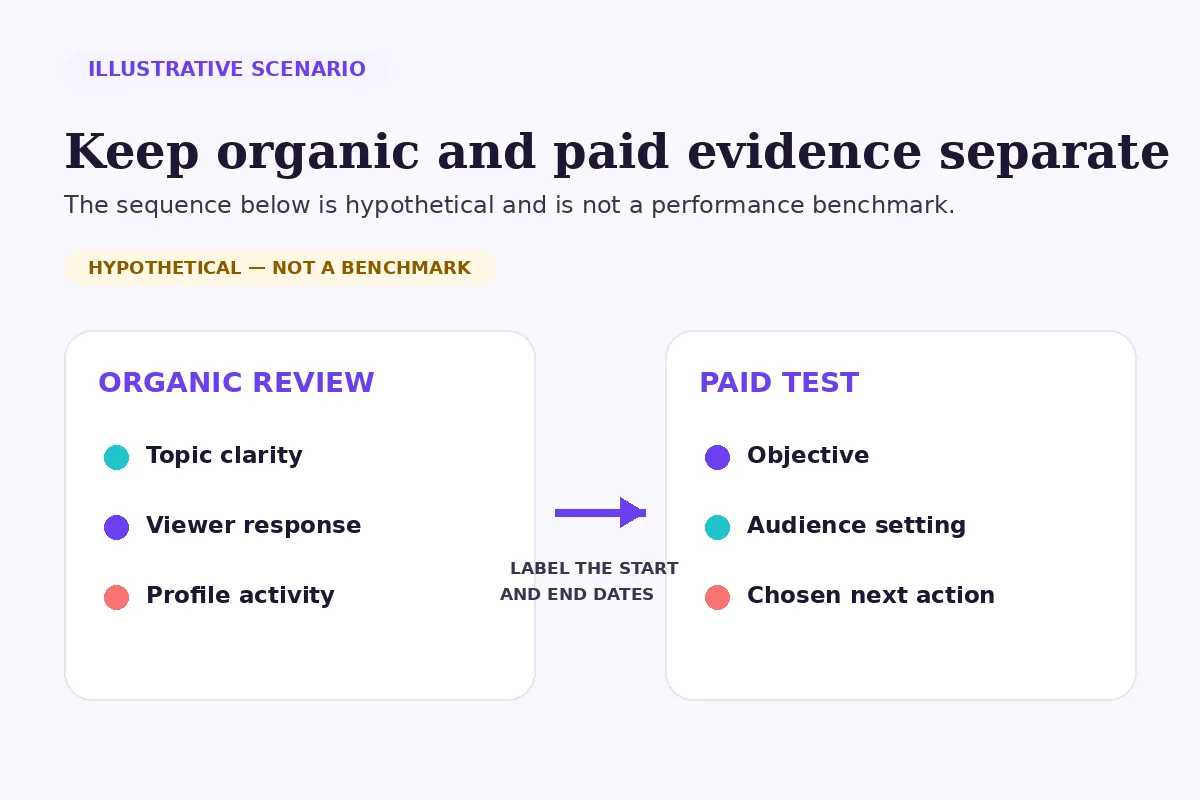
A useful sequence looks like this:
- Define the audience problem and the next action.
- Publish several organic variations without changing every variable at once.
- Review the response in TikTok Studio.
- Select a promotion candidate because it fits the objective, not because it has the biggest vanity number.
- Run one bounded test and label its dates in your reporting.
- Compare the paid result with the goal you set, then decide whether to stop, revise or test again.
What mistakes make the comparison unreliable?
The biggest mistake is treating paid views and organic views as interchangeable. They came through different delivery conditions, so combining them can hide what the content learned organically and what the budget purchased.
Another mistake is changing the creative, audience, destination, duration and goal simultaneously. If the test disappoints, you won’t know which decision mattered. Keep the first experiment deliberately narrow.
Finally, don’t assume the post with the most organic views is automatically the best promotion. A broad entertainment clip might attract attention while a smaller, more specific tutorial produces more relevant profile activity. Start with the campaign job, then choose the creative.
A practical measurement checklist
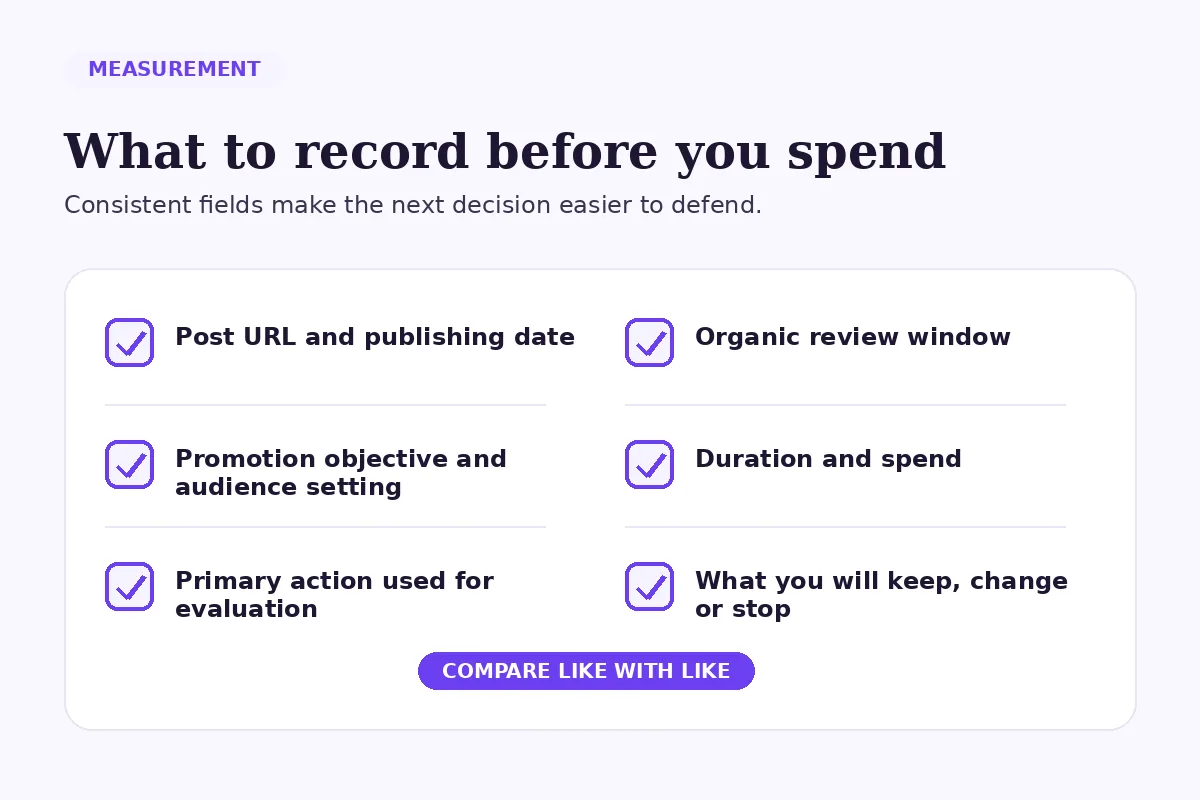
Record the same fields every time so you can compare decisions without manufacturing certainty:
- post URL and publishing date;
- organic review window before any promotion;
- promotion objective, audience setting, duration and spend;
- the primary action you chose to evaluate;
- paid and organic reporting kept separate where TikTok exposes it;
- profile or destination readiness before launch;
- what you’ll keep, change or stop after the test.
If your wider goal is steadier TikTok visibility, FastSocialz’s TikTok growth service can support distribution alongside your own content and community work without requiring your TikTok password. It cannot guarantee followers, reach, ranking, engagement or sales, and it shouldn’t replace organic learning or careful paid-campaign measurement.
Final recommendation
Don’t choose between Promote and organic growth by asking which one is “better.” Ask which uncertainty you’re trying to reduce.
If you don’t yet know what content earns relevant attention, use organic publishing to learn. If you have suitable content and a defined, measurable reason to buy more distribution, consider a bounded Promote test. Keep the data separate, judge the result against the original goal and resist turning a larger counter into a bigger claim.
Structured support, no account access
Where a growth service fits on TikTok
Content and profile conversion come first, and no service changes that. A growth service cannot repair a vague bio, an audience that was never yours, or a post that gives viewers no reason to follow.
What it can do is handle the part most people never get around to: putting your profile in front of the right audience, consistently, while you concentrate on the content. FastSocialz builds campaigns by hand and runs them from your public profile link, so it never asks for your TikTok password and never logs in as you.
Explore TikTok Growth →No growth service can promise that a given number of views will produce a given number of followers.Questions, answered plainly
Frequently asked questions
Is TikTok Promote the same as organic reach?
No. Promote is a paid advertising tool for eligible posts. Organic reach comes through TikTok’s unpaid recommendation and discovery systems.
Should I promote a TikTok that already performed well?
Organic performance can be one useful signal, but it is not enough by itself. The post also needs to fit the paid objective, audience and next action you have chosen.
Does TikTok Promote guarantee followers or sales?
No. Promote can provide paid distribution around a selected objective, but TikTok does not guarantee followers, sales or another business outcome.
Can I promote any TikTok video?
No. TikTok applies account, age, privacy and audio-eligibility requirements. Check the current options shown in your account before planning a campaign.
Does paying for Promote reduce later organic reach?
TikTok’s official Promote and recommendation documentation cited in this guide does not say that using Promote suppresses later organic posts. Keep paid and organic reporting separate so a changed traffic mix is not mistaken for proof of suppression.
Keep reading
Related guides

How to Add Chapters to YouTube Videos
A practical guide to planning, formatting, publishing, and checking YouTube chapters without turning your description into a mess.
YouTube Impressions Up but CTR Down? 7 Checks Before You Change Your Thumbnail
A falling click-through rate is not automatically bad when YouTube is showing your video to more people. Use these seven checks before changing the thumbnail.

YouTube Dynamic Thumbnails vs A/B Testing: What Creators Should Know
YouTube has announced dynamic thumbnails and video-cut testing, but its existing A/B tool works differently. Here is what each option tests and what creators can do now.