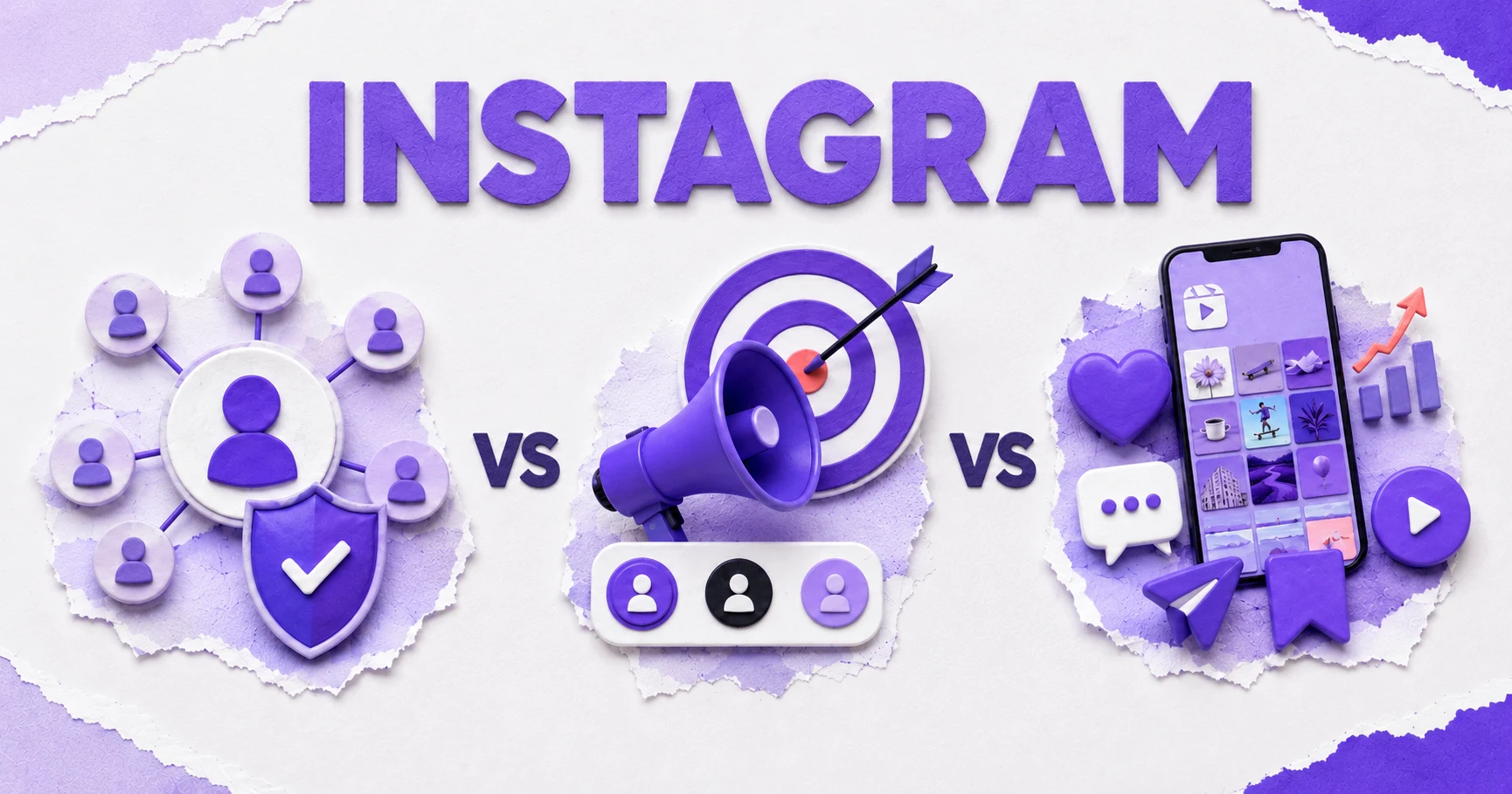
There are three common answers to the question, “How should I grow my Instagram account?”
Post better content. Run ads. Hire a growth service.
All three can be reasonable. They just don’t do the same job.
Organic content gives people a reason to care. Advertising pays to place that content in front of a selected audience. A managed growth service can support discovery and audience-building when you don’t want to handle every part of the process yourself.
The mistake is choosing one before deciding what you actually need. A business that needs registrations for an event next week has a different problem from a creator building authority over the next year. The same strategy shouldn’t be prescribed to both.
This guide compares Instagram growth services, Instagram ads and organic growth using practical criteria: control, cost structure, speed, content requirements, measurement and long-term value. It doesn’t rank providers or claim a universal winner. The best choice depends on the job you need the method to do.
TL;DR: The quick verdict
If your profile is unclear or your content isn’t useful yet, start with organic fundamentals. Paying for more exposure only sends more people to a page that isn’t ready to convert them.
If your content is working but distribution is inconsistent, ads or managed growth support may help. Which one makes more sense depends on whether you want campaign control, ongoing audience development or both.
What are we comparing?
“Instagram growth” is often used as if it describes one result. It doesn’t.
One business may define growth as more relevant followers. Another cares about qualified website visits, enquiries, bookings or sales. A creator may value repeat viewers and meaningful comments more than either of those.
Before comparing the three methods, separate the outcomes:
- Reach: how many accounts saw your content.
- Profile visits: how many people became curious enough to inspect your account.
- Followers: how many chose to see more from you.
- Engagement: how people interacted with the content.
- Business results: leads, purchases, bookings, sign-ups or other valuable actions.
These outcomes are related, but one doesn’t guarantee the next. High reach can produce very few profile visits. A follower increase can produce no sales. An advertisement can be profitable without adding many followers at all.

Instagram’s own Insights tools report trends across content and followers, while individual post insights can show profile activity after someone engages with a post. That distinction matters: reach is an opportunity, not the final result. Instagram’s documentation on Insights explains the available measurements.
Comparison criteria
We’ll judge each method using seven questions:
- What is it designed to achieve?
- How quickly can it create a measurable signal?
- How much control does the account owner have?
- What does it cost in money, time and attention?
- How dependent is it on strong content and a credible profile?
- How easy is it to measure?
- What are its main limitations?
This is a criteria-based comparison, not a hands-on test. Costs, timelines and outcomes vary by niche, geography, offer, creative quality, account history and service model. Any source promising one universal result is skipping the variables that matter most.
Instagram growth service vs ads vs organic growth
| Factor | Organic growth | Instagram ads | Managed growth service |
|---|---|---|---|
| Primary job | Earn attention and trust through content | Buy controlled distribution for a defined objective | Support audience discovery and growth activity |
| Cost model | Mainly time, creative work and production resources | Auction-based media spend, plus creative and management costs | Recurring or fixed service fee |
| Speed | Usually gradual and uneven | Can begin generating data after approval and delivery | Varies by provider, targeting and method |
| Audience control | Indirect; influenced by content and recommendation systems | Comparatively high through campaign settings and optimisation | Varies significantly between providers |
| Content dependency | Very high | High; spending can’t rescue an unconvincing message | High; a service can’t make an empty profile worth following |
| Measurement | Strong for content and profile trends, but attribution can be messy | Strong campaign reporting when tracking is configured properly | Depends on provider reporting and your own Insights |
| Duration | Good content can keep attracting attention | Distribution generally depends on continued spend | Support generally continues while the service is active |
| Best fit | Long-term brand and community building | Launches, offers, retargeting and measurable campaigns | Accounts wanting managed audience-building support |
| Main limitation | Slow, labour-intensive and unpredictable | Costs can rise; results depend on the objective, creative and offer | Quality, transparency and account-access requirements vary |
There’s a pattern here: organic growth creates the foundation, ads create controlled reach, and a growth service can reduce the manual burden around audience development. They overlap, but they aren’t interchangeable.
Option 1: Organic Instagram growth
Organic growth means earning discovery without directly paying Instagram to distribute a post. It includes Reels, carousels, Stories, collaborations, searchable captions, community participation and the less glamorous work of making a profile easy to understand.
People sometimes describe this route as “free.” That’s only true if your time has no value. Planning, filming, editing, writing, publishing and responding all cost something—even when no advertising invoice arrives.
Where organic growth is strongest
Organic content is the best of the three methods for showing people what you know, how you think and why your account deserves another visit. Over time, it can create a library of useful content rather than a temporary burst of distribution.
It also gives you the clearest feedback on the substance of your message. If several posts reach the right people but almost nobody visits the profile, the hook may be doing all the work. If people visit but don’t follow, the profile promise may be unclear. We explored that second problem in Instagram Reels Getting Views but No Followers?.
Instagram can recommend eligible content to people who don’t follow the account across places such as Reels, Feed, Explore, Search and Suggested Accounts. Eligibility doesn’t guarantee recommendation, but it is a necessary condition for broader discovery. Account owners can review the platform’s recommendation eligibility guidance when reach appears unexpectedly limited.
The limits of an organic-only plan
Good organic work can still be inconsistent. A strong post may travel; the next one may not. The account owner has control over the message and publishing process, but not over how much recommendation traffic Instagram will provide.
Organic growth is also easy to abandon too early. Three rushed Reels and a week of Stories aren’t a strategy. At the same time, “just keep posting” is weak advice when the positioning, topic selection or profile conversion is broken.
Best fit: educators, experts, creators and brands building trust over time; accounts with more creative capacity than advertising budget; businesses still learning which messages resonate.
Less suitable as the only method: time-sensitive launches, urgent event promotion or offers that need predictable distribution within a fixed window.
Option 2: Instagram ads
Instagram advertising lets you pay for distribution through Meta’s advertising system. Depending on the setup, campaigns can support awareness, traffic, engagement, leads, app activity or sales-related objectives.
This is the key difference: ads are built around a campaign outcome. They aren’t simply an “organic growth” button with a budget attached.
What ads give you that organic content doesn’t
Advertising provides more control over who may see a message, how much you are prepared to spend, when the campaign runs and what outcome the system should optimise toward. It can also help you retarget people who already interacted with your business, provided the required tracking and audience setup are available.
Meta doesn’t publish one fixed price for Instagram advertising. Delivery is determined through an auction, and costs vary with factors such as audience, objective, competition, placements, creative and bid strategy. Meta explains this auction-based model in its guidance on the cost of Instagram ads.
That makes a universal claim like “Instagram ads cost $X per follower” unreliable. Two businesses can use similar budgets and receive very different results because the ads, audiences, offers and conversion paths aren’t the same.
Why ads don’t automatically produce a loyal audience
An ad can win attention without earning trust. It may generate video views, clicks or profile visits while producing few followers. That isn’t necessarily campaign failure; it may mean the chosen objective was something else.
Problems usually appear when the business treats exposure as the complete strategy. Someone sees the ad, visits the profile and finds an unclear bio, inconsistent content or no obvious reason to return. The media did its job. The profile didn’t finish it.
Ads also stop behaving like organic assets once the budget stops. A useful organic post may continue being shared or discovered. Paid distribution normally needs continued spending, even if the campaign data improves future decisions.
Best fit: product launches, event registrations, lead generation, retargeting, local promotions and businesses with a defined objective and a working conversion path.
Less suitable as the first move: accounts that haven’t validated their message, don’t know what action they want from visitors, or lack the capacity to produce and test creative.
Option 3: A managed Instagram growth service
A managed growth service — the model behind our own Instagram growth service — sits between do-it-yourself organic activity and paid media. Instead of buying ad impressions directly from Instagram, you pay a provider to support part of the audience-building process.
That description is intentionally broad because providers use very different methods. Some require access to the social account. Some use software. Some focus on strategy or content. Others perform external discovery and engagement activity without needing the customer’s password.
Those differences shouldn’t be treated as fine print. They are the service, which is why we publish how our process works in plain language.
What to check before choosing a provider
Ask direct questions before paying:
- Does the provider need your Instagram password?
- What work is actually performed?
- How is audience relevance determined?
- Can you pause or cancel the service?
- What reporting will you receive?
- Does the provider promise a guaranteed number of followers or business results?
- Are limitations explained clearly, or hidden behind vague language?
Be cautious when a service promises a fixed level of organic reach, engagement or sales. No outside company controls Instagram’s recommendation system or a viewer’s decision to buy.
Account access deserves particular attention. Handing over a password creates a different security and control relationship from using a service that doesn’t require login credentials. Even when access is technically convenient, the account owner should understand why it is requested and what activity will occur.
What a growth service can—and can’t—do
A well-defined service can save time and support consistent audience discovery. It may be useful for a business owner who publishes credible content but can’t manage every growth task alongside sales, delivery and customer support.
It can’t manufacture a strong brand position. If the profile doesn’t explain whom it helps, if recent posts are unrelated, or if the content gives visitors no reason to stay, added discovery may simply expose those weaknesses faster.
Best fit: established profiles with a clear niche, consistent content and limited time for ongoing audience-building activity.
Less suitable as the first move: empty or confusing accounts, businesses expecting automatic sales, or anyone unwilling to examine the provider’s methods and terms.
Which one should you choose?
The most useful answer begins with your constraint—not your favourite tactic.
Choose organic growth when your message still needs work
Imagine a consultant who has expertise but hasn’t settled on three or four topics worth owning. Advertising would give the uncertainty a larger audience. A managed service would create more discovery, but the profile still wouldn’t make a clear promise.
The first job is editorial: define the audience, sharpen the bio, publish a small set of useful posts and observe what produces saves, shares, profile visits and follows. Organic work is the research stage as much as the growth stage.
Choose ads when timing and campaign control matter
Now imagine a local studio opening a new branch in four weeks. The offer has a deadline, a location and a defined action: book a trial session.
Organic content should still explain the experience and build confidence. But ads are the better distribution tool when the business needs to reach a relevant local audience during a specific period and measure campaign actions.
Follower count is secondary in this scenario. Bookings are the point.
Consider managed growth when execution time is the bottleneck
Consider a creator who already posts useful content three times a week. The profile is coherent, viewers frequently visit it, and some convert into followers—but the creator has little time for broader discovery and audience-development work.
A transparent managed service — with scope and pricing stated up front — may support the existing system. The creator should still track account-level trends and content quality rather than judging the service by a follower number alone.
Use a blended strategy when the parts already work
An ecommerce brand might use organic posts to demonstrate products, ads to promote a seasonal offer, and managed growth support to maintain broader audience discovery. Each method has a specific assignment.
This is very different from paying for all three and hoping the numbers rise. A blended strategy only works when each layer has a purpose and its own measurement.
A practical decision path
Start with these questions in order:
- Is the profile ready? A new visitor should understand who the account is for, what it publishes and why following would be useful.
- Is the content creating any signal? Look for relevant reach, profile visits, saves, shares, replies and follows—not just the largest visible number.
- Is there a time-sensitive business objective? If yes, ads may deserve priority.
- Is lack of execution time limiting consistent audience development? If yes, investigate managed support.
- Can you measure the result that matters? Decide this before spending, not afterward.
If the answer to the first two questions is no, don’t rush to add more distribution. Fix the foundation first.
A simple 30-day blended plan
You don’t need to lock yourself into one method forever. A short, controlled cycle can show where the real constraint sits.
Week 1: Repair the foundation
- Rewrite the bio around one audience and one clear promise.
- Review the last nine to twelve posts for topic consistency.
- Pin the posts that best introduce the account.
- Record baseline reach, profile visits, follows and meaningful business actions.
Week 2: Test the message organically
- Publish content that addresses two or three specific audience problems.
- Use more than one format where practical.
- Note which posts create profile visits and follows, not merely views.
- Respond to genuine comments and questions while the content is active.
Week 3: Add one distribution layer
Choose either a small, purpose-built ad campaign or a managed growth service—not both on the same day if you want to understand the effect clearly.
For ads, define the objective and tracking before launch. For a service, document the starting metrics, method, account-access requirements and cancellation terms.
Week 4: Compare quality, not just quantity
Review:
- profile visits from relevant audiences;
- follows relative to profile visits;
- saves, replies and meaningful comments;
- website actions, enquiries or sales where applicable;
- cost in money and working time;
- whether the new audience resembles the people the account is meant to serve.
One month won’t prove long-term growth. It can, however, reveal whether the biggest issue is content, distribution, conversion or measurement.
Common mistakes when making the decision
Comparing unlike outcomes
An organic Reel’s reach, an ad campaign’s clicks and a growth service’s follower trend aren’t interchangeable. Choose one primary outcome and a few supporting indicators.
Calling organic growth “free”
Ignoring production time makes the comparison unfair. A weekly filming day, editing support and community management are real inputs.
Optimising ads for followers by accident
If the business needs sales or leads, don’t let follower growth become the unofficial success metric simply because it is visible.
Expecting a service to replace content
Discovery creates a visit. The profile and content decide what happens next.
Changing everything at once
If you redesign the profile, double content output, launch ads and start a service in the same week, you may see movement without learning what caused it.
Trusting certainty where none exists
No responsible provider can promise that Instagram will recommend a post, that a visitor will follow, or that a follower will become a customer. Clear limitations are a sign of a more credible comparison—not a weakness.
Sources and methodology
This article is a criteria-based editorial comparison. It does not rely on invented provider tests, customer outcomes or universal performance benchmarks.
Platform claims were checked against the official Instagram and Meta resources linked in the relevant sections above: Instagram Insights, recommendation eligibility and Meta’s explanation of Instagram advertising costs.
Service details can change. Readers should verify current scope, access requirements, pricing and terms on the provider’s own website before making a decision.
Final recommendation
Start with organic content because every other method sends people back to the profile you’ve built. Once that foundation can turn some relevant visitors into followers—or customers—choose the next layer based on the constraint.
Use ads when you need controlled distribution for a defined campaign. Consider managed growth support when consistent audience-development work is the bottleneck. Combine them only when you can explain what each part is supposed to accomplish.
The best Instagram growth strategy in 2026 isn’t the one with the loudest promise. It’s the one that matches your goal, respects the limits of each method and leaves you with information you can use for the next decision.
Before comparing any of these routes, confirm Instagram can recommend you at all — our explainer on what “eligible for recommendation” means shows what Account Status does and does not prove.
Questions, answered plainly
Frequently asked questions
Do Instagram ads help you gain followers?
They can. Ads may introduce your account to relevant people and generate profile visits, some of which can become followers. But the result depends on the campaign objective, creative, audience and profile. Instagram advertising doesn’t guarantee follower growth.
Is organic Instagram growth really free?
Organic distribution doesn’t require media spend, but creating content takes time and may involve equipment, editing, design or staff costs. It is better described as non-paid distribution than cost-free growth.
Do Instagram growth services need your password?
Some providers request account access and others don’t. Ask why access is required and what activity will take place before sharing credentials. FastSocialz’s Instagram Growth service does not require your Instagram password.
Which method is cheapest?
There is no universal cheapest option. Organic growth may require less cash but more working time. Ads allow flexible budgets but operate through an auction. Managed services usually charge a defined fee, while their scope and methods vary. Compare total cost against the outcome you need.
Can I use organic content, ads and a growth service together?
Yes, provided each has a clear role. Organic content can build trust, ads can support specific campaigns, and a managed service can assist ongoing audience development. Introduce changes carefully enough that you can still evaluate what is working.
What should I measure besides followers?
Track relevant reach, profile visits, follows relative to visits, saves, shares, meaningful comments and business actions such as enquiries or purchases. The right mix depends on your goal, but follower count alone gives an incomplete picture.
Keep reading
Related guides
How to Add Chapters to YouTube Videos
A practical guide to planning, formatting, publishing, and checking YouTube chapters without turning your description into a mess.
YouTube Impressions Up but CTR Down? 7 Checks Before You Change Your Thumbnail
A falling click-through rate is not automatically bad when YouTube is showing your video to more people. Use these seven checks before changing the thumbnail.
YouTube Dynamic Thumbnails vs A/B Testing: What Creators Should Know
YouTube has announced dynamic thumbnails and video-cut testing, but its existing A/B tool works differently. Here is what each option tests and what creators can do now.